

Tax Rules on Intra Group Loans
The Malaysia Transfer Pricing Guidelines on Controlled Financial Transactions released on 30 July 2026, serve as a supplement to Chapter 9 of the Malaysia Transfer Pricing Guidelines and establish detailed rules on pricing, economic substance, and documentation for related-party financing.
Introduction
The Inland Revenue Board of Malaysia (“IRB”) had published the Malaysia Transfer Pricing Guidelines
on Controlled Financial Transactions: Intra-Group Loans (“MFTIL Guidelines”) on 30 July 2026. These
Guidelines serve as a comprehensive guide to determine the arm’s length nature of the intra-group loans
and serves as an essential supplement to the broader Malaysia Transfer Pricing Guidelines 2024.
Under the new MFTIL Guidelines, setting an arm’s-length interest rate for related-party financing requires a four-step framework: accurately characterizing the transaction, evaluating functional profiles, assigning risks, and executing a formal market benchmarking analysis. These core strategies, form the foundation of the guideline’s four structural chapters.
Under the new MFTIL Guidelines, setting an arm’s-length interest rate for related-party financing requires a four-step framework: accurately characterizing the transaction, evaluating functional profiles, assigning risks, and executing a formal market benchmarking analysis. These core strategies, form the foundation of the guideline’s four structural chapters.
Chapter 1: The Ultimate Reality Check (Debt vs. Equity)
The IRB closely scrutinizes intra-group financing to detect hidden equity structured as corporate debt. If a transaction is found to lack the commercial and economic substance of a genuine loan, the Director General can recharacterise it as equity, disallow your corporate interest deductions, and impose statutory surcharges.
| Criteria | Debt | Equity |
|---|---|---|
| a. Existence of a legal obligation to repay | Fixed and enforceable obligation to repay principal and interest | No obligation to repay; repayment depends on profits or discretion of the management |
| b. Fixed maturity date | Repayment scheduled on a specific date or upon demand | No fixed maturity, redeemable at issuer's discretion |
| c. Expectation of return | Interest is predetermined | Return depends on profits/ dividends |
| d. Ranking upon liquidation or dissolution | Ranks as a creditor (before equity holders) | Ranks as equity (after debt obligations) |
| e. Participation in management or control | No participation in the borrower's management | Usually includes voting rights or influence in management |
| f. Right to enforce repayment | Enforceable in courts as a debt contract | Legal recourse is limited; depends on the residual claim |
| g. Treatment in accounting and financial reports | Liability | Equity |
| h. Tax treatment under the relevant tax laws | Treated as interest-bearing loan | Treated as capital contribution or equity |
| i. Intent of the parties | Debtor-creditor relationship | Ownership interest |
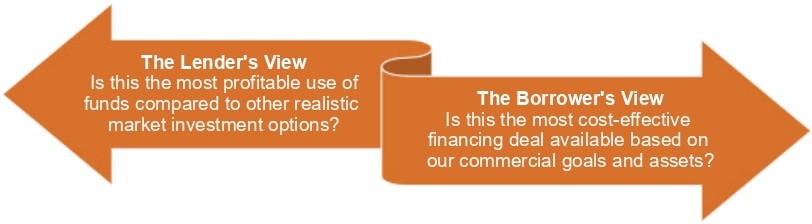
Chapter 2: The Double Lens Principle
Taxpayers are prohibited from setting interest rates for related-party loans without proper economic
justification. To comply with transfer pricing rules, the interest rate must reflect market realities by
considering the commercial positions of both the lender and the borrower.
The golden rule here is creditworthiness. Multinational groups must formally evaluate and retain credit
reports from recognized agencies like RAM Ratings, Moody’s, or Standard & Poor’s (S&P). For local
Malaysian Small & Medium Enterprises (SMEs), using reporting systems like CTOS and CCRIS is
acceptable to justify commercial risk profiles.
The MFTIL Guidelines state that membership in a Multinational Enterprise (“MNE”) group affects a subsidiary’s borrowing conditions in two distinct ways:
1) Group Policy Influence: The overarching financial policies of the MNE group often shape the specific loan types, terms, and pricing available to the entity from independent lenders.
2) Implicit Group Support: Lenders may offer lower borrowing costs and higher credit ratings based on the passive expectation that the MNE parent will assist during financial distress. This type of passive economic benefit is called “implicit support”. Because it arises automatically from being part of the group, it does not require any intercompany service fees or transfer pricing adjustments.
The MFTIL Guidelines state that membership in a Multinational Enterprise (“MNE”) group affects a subsidiary’s borrowing conditions in two distinct ways:
1) Group Policy Influence: The overarching financial policies of the MNE group often shape the specific loan types, terms, and pricing available to the entity from independent lenders.
2) Implicit Group Support: Lenders may offer lower borrowing costs and higher credit ratings based on the passive expectation that the MNE parent will assist during financial distress. This type of passive economic benefit is called “implicit support”. Because it arises automatically from being part of the group, it does not require any intercompany service fees or transfer pricing adjustments.
Chapter 3: Arm’s Length Compliance
A comparability analysis can assist to determine the appropriate pricing approach for establishing the
arm’s length interest rates. Taxpayers must select the most suitable pricing approach to calculate and
justify their cross-border or domestic intra-group interest rates.
| Pricing approach | Description |
|---|---|
| Comparable Uncontrolled Price Method ("CUP Method") |
|
| Cost of Funds Method |
|
| Comparable Uncontrolled Price Method ("CUP Method") |
|
According to the MFTIL Guidelines, taxpayers are permitted to review the arm’s length interest rates
established through the most appropriate pricing method, other than the simplified method, once every
three (3) years in order to minimise compliance costs, provided that all facts and circumstances remain
unchanged.
Chapter 4: Compliance Action Plan
The MFTIL Guidelines mentions that the taxpayer engaged in intra-group loans is required to maintain
relevant documentation as follows:
- Agreements
- Credit assessments
- Supporting evidence demonstrating compliance
- Terms of the intra-group loans
- Interest charged
Conclusion
With the introduction of the MFTIL Guidelines, the IRB is setting an expectation on the taxpayer to study
if the intra-group loan that they receive or provide is consistent with the arm’s length principle. Therefore,
taxpayers with existing intra-group loans should focus on:
1. Reviewing the existing intra-group loan, if it has debt or equity characteristics.
2. Assessing the creditworthiness of the related party borrower and document the assessment.
3. Evaluating the most appropriate method to establish the arm’s length interest rates.
4. Studying the current documentation in relation to the intra-group loans, to determine if they meet the compliance requirements.
1. Reviewing the existing intra-group loan, if it has debt or equity characteristics.
2. Assessing the creditworthiness of the related party borrower and document the assessment.
3. Evaluating the most appropriate method to establish the arm’s length interest rates.
4. Studying the current documentation in relation to the intra-group loans, to determine if they meet the compliance requirements.