Categories
Ideas & Insights Newsletter Tax

Introduction of New Tax Instalment Payment Schedule Effective YA 2028

Newsletters

Key Takeaway

From YA 2028, instalments start in the first month, with revisions allowing payments to align with updated tax estimates.
Under the existing rules, companies generally commence payment of their estimated tax from the second month of the basis period. Following the amendment, instalment payments will commence from the first month of the basis period.

Effective Date

The amendment will apply from Year of Assessment (“YA”) 2028 onwards. A transitional provision applies to YA 2027, under which companies will continue to commence their instalment payments from the second month of the basis period.
Year of Assessment Commencement of instalment payments
YA 2027 Second month
YA 2028 onwards First month
The change effectively brings forward the first tax instalment by one month and should therefore be considered in the company’s cash-flow planning.

Example:

Current Treatment
YA2028 and Subsequent years of assessment
The first instalment payment for the tax estimate shall be made in the second month of the taxpayer’s basis period and shall end in the first month of the basis period for the following year of assessment.
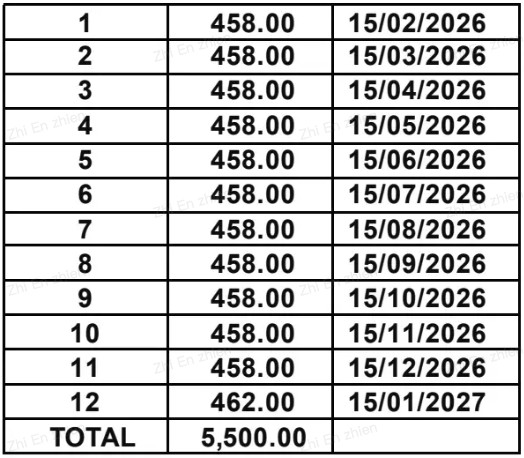
Current Treatment
1st instalment will be amended as the 1st month of the basis period and the last instalment ends in the same YA. Transitional period applicable for YA 2027 where the 1st instalment shall commence in the 2nd month and ended within the number of months in the basis period for YA 2027 (less one month).
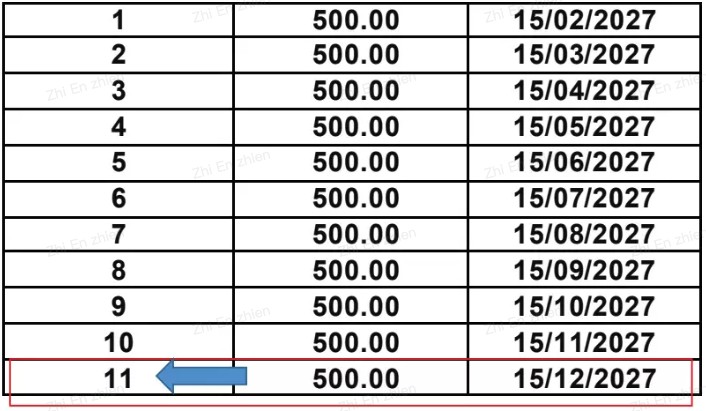
Key considerations for businesses

The earlier commencement of instalment payments from YA 2028 onwards may have a direct impact on companies’ tax cash-flow requirements.

Companies should consider:

  • updating their tax payment calendars for YA 2028 onwards;
  • incorporating the first-month instalment into cash-flow forecasts;
  • monitoring projected taxable profits throughout the basis period; and
  • reviewing whether a CP204A revision is appropriate where the original tax estimate is no longer representative.

Categories
Ideas & Insights Newsletter Tax

Optimizing Business and Investments with an Investment Holding Company

Newsletters

Key Takeaway

IHCs are subject to specific statutory provisions, which may affect expense deductions, capital allowances and the overall tax position.

Introduction

An Investment Holding Company (“IHC”) may provide a practical structure for separating investment assets from a group’s operating businesses. However, the suitability of an IHC should be assessed in the context of the group’s overall commercial objectives, particularly where tax efficiency is a key consideration.

The Inland Revenue Board of Malaysia (“IRBM”) has issued Public Ruling No. 2/2024 – Investment Holding Company, which sets out the relevant tax framework applicable to IHCs under the Income Tax Act 1967.

Why Does The Choice Of Structure Matter?

The decision to establish an Investment Holding Company (“IHC”) should be based solely on corporate and accounting considerations. The choice of structure may have significant tax implications, particularly as the nature of the company’s activities and sources of income may affect the tax treatment and deductibility of expenses incurred in holding and managing investments.

An IHC may incur various expenses, including:

  • directors’ and management expenses;
  • professional and advisory fees;
  • financing costs;
  • property-related expenses; and
  • other costs associated with the holding and management of investments.
For an unlisted IHC, section 60F provides a specific mechanism for determining the amount of certain expenses that may be deducted for tax purposes. These rules include a prescribed formula and a limitation linked to the investment income of the company.

An IHC should not be established on the assumption that:
higher expenditure = higher tax deduction.
The amount of accounting expenditure incurred does not necessarily translate into an equivalent tax deduction. The actual tax benefit may be substantially lower, particularly where the IHC is expected to incur significant recurring management, professional, administrative, and other investment-related costs.

The distinction between an operating company and an IHC

An operating company generally derives income from carrying on a business. An IHC, on the other hand, is principally concerned with holding investments and deriving income from those investments. This distinction is significant because the Income Tax Act 1967 contains specific provisions dealing with IHCs, including sections 60F and 60FA.

The tax rules applicable to an IHC are therefore not necessarily the same as those applicable to an ordinary operating company. This is particularly relevant where a group intends to move existing investments from an operating company into a newly incorporated IHC.

Capital Expenditure Should Also Be considered

Where an IHC acquires investment properties or other qualifying assets, the group may expect the associated capital allowances to reduce its overall taxable income. However, the IHC rules may restrict the utilisation of capital allowances depending on the income generated by the relevant source.

Conclusion

An IHC can be an effective corporate structuring vehicle, but it should not automatically be regarded as a tax-saving solution. The tax framework applicable to IHCs contains specific rules that can restrict the benefit of expenses, investment losses and capital allowances.
Categories
Ideas & Insights Newsletter Tax

Is Foreign Income Subject to Tax for Individuals?

Newsletters

Key Takeaway

Foreign income received in Malaysia may be taxable, with specific exemptions, conditions, documentation, and double-taxation relief available.
Malaysia generally operates on a territorial basis of taxation. Under section 3 of the Income Tax Act 1967 (“ITA 1967”), income accruing in or derived from Malaysia, as well as income received in Malaysia from outside Malaysia where applicable, may fall within the Malaysian income tax framework.

With effect from 1 January 2022, foreign-sourced income (“FSI”) received in Malaysia by a Malaysian resident is, in principle, brought within the scope of Malaysian taxation. However, specific exemptions are available for qualifying resident individuals.

For resident individuals, the key exemption is contained in the Income Tax (Exemption) (No. 5) Order 2022 [P.U.(A) 234/2022], as amended. The exemption generally covers foreign income received in Malaysia, other than income from a partnership business in Malaysia, subject to the relevant conditions.

What is “Income Received from Abroad”?

For purposes of the exemption order, “income received in Malaysia from outside Malaysia” refers to income arising from outside Malaysia which is brought into Malaysia. Accordingly, the distinction between:

  • income arising from Malaysia;
  • income arising outside Malaysia; and
  • whether the foreign income is actually received in Malaysia

is important in determining the Malaysian tax treatment.
Examples of foreign income potentially relevant to an individual include:

  • foreign employment income;
  • foreign business or professional income;
  • foreign dividends;
  • foreign interest;
  • foreign rental income;
  • foreign royalties; and
  • other income of an income nature.

Exemption for Resident Individuals

A resident individual may qualify for an exemption from Malaysian income tax on most types of foreign income received in Malaysia under section 4 of the ITA 1967. However, this exemption does not apply to income from a partnership business in Malaysia.

One of the main conditions is that the foreign income must generally have been subject to a tax similar to income tax in the country where the income was earned. This condition may still be met in situations where:

  • Income tax or withholding tax was charged or paid in the foreign country;
  • No tax was charged because of the foreign country’s tax system;
  • The income was below the foreign country’s tax-free threshold;
  • The income was exempt from tax under a tax incentive; or
  • For certain foreign dividend income, the income was subject to tax at an underlying level or came from profits that benefited from certain tax rules or incentives.

Duration of the Individual Exemption – Important Update

The original exemption order applied from 1 January 2022 to 31 December 2026. However, the Income Tax (Exemption) (No. 5) Order 2022 (Amendment) Order 2024 amended the expiry date from 31 December 2026 to 31 December 2036.

Foreign Tax Credit – Where Malaysian Tax Arises

Where foreign income is not exempt, Malaysian tax may arise where the income falls within the Malaysian charging provisions. Where the same income is also subject to foreign tax, relief from double taxation may potentially be available under:

  • section 132 ITA 1967, where an applicable double taxation agreement or the relevant statutory conditions apply; or
  • section 133 ITA 1967, for unilateral relief in appropriate circumstances.
Categories
Ideas & Insights Newsletter Tax

Caregiving Leave Additional Employer Tax Deduction

Newsletters

Key Takeaway

Employers can claim extra tax deductions for eligible caregiving leave.
The Income Tax (Deduction for Payment of Additional Paid Leave for the Care of Child or Sick or Disabled Immediate Family Member) Rules 2026 [P.U. (A) 289/2026] were gazetted on 11 August 2026, introducing an additional tax deduction for qualifying employers that provide additional paid leave to employees to care for:

  • a child; or
  • a sick or disabled immediate family member.

The following employers are NOT eligible for this tax incentive:

  • companies directly or indirectly controlled by the employee
  • sole proprietorships, or
  • employers that are relatives of the employee, including:
    • a parent including a parent-in-law
    • a child including a stepchild or an adopted child
    • a sibling
    • a grandparent, a grandchild or a spouse.
What is the tax benefit? Who is considered an immediate family member? What are the key conditions?
  • A qualifying employer can claim an extra tax deduction of 50% of the qualifying salary paid to a full-time employee who is given additional paid leave to:
    • care for a child under 2 years old;
    • care for a sick immediate family member; or
    • care for an immediate family member with a disability.
  • spouse;
  • parents, including parents-in-law, step-parents and adoptive parents;
  • children, including stepchildren and adopted children;
  • siblings, including step-siblings and adopted siblings; and
  • grandparents
  • The employee must be a full-time employee;
  • For a sick immediate family member, a medical certificate from a Malaysian Medical Council-registered medical practitioner must confirm that a caregiver is required;
  • For a disabled immediate family member, certification from Department of Social Welfare must confirm that the family member is a person with a disability.
  • The relevant conditions are subject to verification by Talent Corporation Malaysia Berhad from 1 January 2025 to 31 December 2027.
  • The additional deduction is limited to 12 consecutive months for each year of assessment
Categories
Ideas & Insights Newsletter Tax

6% Service Tax Exemption On Certain Construction Services To Overseas Customers

Newsletters

Key Takeaway

Qualifying construction services to overseas customers are exempt from service tax.
The Royal Malaysian Customs Department has issued Service Tax Policy No. 5/2026, introducing a service tax exemption for certain construction services provided to customers outside Malaysia.

The exemption covers:

  • Construction of offshore facilities
  • Construction of onshore facilities
  • Conversion of ships into floating structures

The exemption applies where the customer is not established in Malaysia.

What Does This Mean For Businesses

If you are a Malaysian construction service provider carrying out qualifying work for a foreign customer, you generally do not need to charge or collect service tax on the qualifying services, provided the conditions under the policy are met.

The exemption applies with effect from 1 July 2025, notwithstanding that Service Tax Policy No. 5/2026 was only issued by the Royal Malaysian Customs Department on 8 September 2026.

However, the exemption is subject to specific conditions and documentation requirements.The service provider must:

  • Be registered under Group L of the Service Tax Regulations 2018;
  • Have a written and signed contract with the overseas customer;
  • Ensure the contract is stamped for stamp duty purposes;
  • Include the prescribed exemption statement on the invoice;
    “Service tax exemption under paragraph 34(3)(a) and subsection 34(4) of the Service Tax Act 2018 pursuant to Service Tax Policy No. 5/2026 dated 8 September 2026.”
  • Maintain the relevant contracts, invoices and supporting documents to substantiate the exemption and for verification by the Royal Malaysian Customs Department.

Service Tax Already Collected

Where service tax has already been charged and collected from customers from 1 July 2025 onwards, the amount collected must still be accounted for and paid to the Royal Malaysian Customs Department. Businesses should note that the policy does not provide for a refund of service tax that has already been collected, even if the services may now qualify for the exemption.
Categories
Ideas & Insights Newsletter Tax

At What Point Is Social Media Income Taxable

Newsletters

Key Takeaway

Influencer income is taxable under Section 4(a) of the ITA, whether received in cash or in kind, and whether from local or overseas platforms.
With the rapid growth of the creator economy, the Inland Revenue Board of Malaysia (“IRBM”) has issued the Guidelines on the Tax Treatment of Income Derived by Social Media Influencers on 14 January 2026, providing clearer guidance on how income arising from influencer activities is treated for income tax purposes.

Income earned through social media cannot be overlooked simply because it is received through digital platforms, paid by overseas companies, or provided in non-cash form. From platform monetisa- tion and brand sponsorships to promotional fees, free products and other benefits, influencers may have income tax obligations that extend well beyond their cash receipts. This Tax Newsletter highlights the key tax considerations under the Guidelines.

Who Is a Social Media Influencer for Tax Purposes?

Under the Guidelines, an individual may be regarded as a social media influencer if they use their influence, knowledge, position or relationship with users to influence others through social or digital media. In simple terms, the Guidelines may apply to individuals who use social media to create content, promote products or services, or generate income through their online influence.

Influencer activities may include:
content-icon

Creating content

producing, recording, publishing, uploading or displaying written, audio or video content.
appearance-icon

Making appearances

participating in programmes, activities or events through social media.
Promoting-icon

Promoting products or services

advertising, endorsing or marketing products or services online.
income-icon

Receiving income or benefits

earning money or receiving gifts, products, services or other benefits from social media activities.
The Guidelines recognise two broad categories of social media influencers:
Category Examples Tax Treatment
Individual Influencer Artistes, athletes, professionals, students, homemakers and other content creators Income earned by individual influencers is generally treated as business or professional income under Section 4(a) of the ITA. This applies whether the income is earned under a formal contract or an informal arrangement.
Object-Based Influencer Animated or cartoon characters; film or drama characters; logos, symbols; or names associated with an organisation or company
(Eg; Upin & Ipin and BoBoiBoy)
The account or character owner receiving the income is generally subject to tax.

If the copyright owner and account owner are different, the tax applies to the party that ultimately receives the income.

Types of Income Subject to Tax

Income Type Examples
Social Media Monetisation Payments based on views, likes, followers, advertisements, subscriptions and clicks
Brand Collaborations Sponsorship, endorsement, promotional and campaign fees
Sale of Products Merchandise and other products sold through social media
Sale of Social Media Accounts Sale or transfer of social media accounts or IDs
Royalties Royalties from characters or content used on social media
Non-Cash Benefits Free products, services, vouchers, discounts and other benefits
Income from Overseas Platforms Payments received from foreign social media platforms
Overseas Promotional Activities Promotional work carried out overseas as part of the influencer's Malaysian profession

Claimable expenses

Influencers may claim tax deductions under Section 33(1) of the Income Tax Act 1967 (“ITA”) for expenses wholly and exclusively incurred in generating their influencer income. These may include internet and data costs, filming and editing fees, content production costs and other expenses directly related to the influencer’s income-generating activities.

Capital Allowance

Influencers may claim capital allowances under Schedule 3 of ITA on qualifying assets used in their influencer activities, such as cameras, lighting equipment and other content production equipment, subject to the applicable conditions.
Categories
Ideas & Insights Newsletter Tax

RM3 Million e-Invoice Exemption Threshold: Eligible Taxpayers May Discontinue e-Invoice Issuance Without Prior HASiL Approval

Newsletters

Key Takeaway

  • The e-Invoice implementation threshold has been increased from RM1 million to RM3 million, effective 1 September 2026.
  • Taxpayers who have already started e-Invoicing but now qualify for the exemption may stop issuing e-Invoices without applying to HASiL.
The Inland Revenue Board of Malaysia (“IRBM”) has clarified that businesses with annual turnover or revenue below RM3 million that satisfy the prescribed exemption criteria will not be subject to compliance action or penalties, even if they have not issued e-Invoices from their applicable implementation date. The clarification was provided in the latest e-Invoice Frequently Asked Questions (FAQ) issued by IRBM dated 4th August 2026.

Immediate Cessation of e-Invoice Without Prior Approval

Taxpayers who qualify for the e-Invoice exemption but have already commenced e-Invoice implementation may discontinue issuing e-Invoices immediately. Importantly, taxpayers are not required to submit a separate application to IRBM or obtain prior approval to cease e-Invoice implementation.

Under the latest clarification, taxpayers with annual turnover or revenue below RM3 million who satisfy the exemption conditions set out in Section 1.6.10 of the e-Invoice Guideline are eligible for the exemption.

Voluntary e-Invoice Implementation Remains an Option

Businesses that qualify for the exemption are not prohibited from continuing with e-Invoice implementation. Taxpayers may voluntarily continue issuing e-Invoices if they consider it beneficial for their business operations, accounting processes or broader digitalisation efforts.

Tax Incentives

The e-Invoice FAQs also summarise the tax incentives available to eligible taxpayers in relation to e-Invoice implementation, including Accelerated Capital Allowance (ACA) incentives. The applicable incentives, together with their legislative reference or status, key details, and effective period, are set out in a table.

Special Voluntary Disclosure Programme (“SVDP”)

FAQs No 123–133 provide taxpayers with greater certainty on the practical application of the e-Invoice SVDP, particularly in relation to historical rectification, the 72-hour cancellation rule, incorrect classifications, subsequent disclosures, consolidated e-Invoices, group entities and third-party service providers. Taxpayers should consider undertaking a review of their historical e-Invoice transactions to identify any outstanding non-compliance and, where appropriate, regularise the position during the SVDP period ending 31 December 2027.
Categories
Ideas & Insights Newsletter Transfer Pricing

Transfer Pricing Rules 2023 & 2024 Transfer Pricing Guidelines

Newsletters

TP Rules 2023

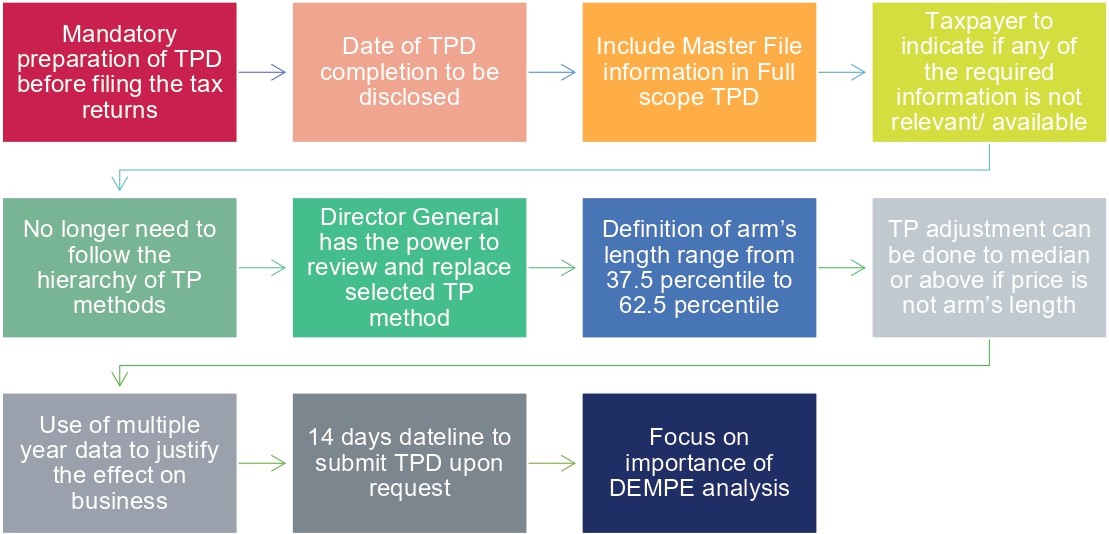
The Income Tax (TP) Rules 2023 (“2023 TP Rules”) were officially released and gazetted on 29 May 2023.The rules were issued by the Ministry of Finance and the Inland Revenue Board of Malaysia (“IRBM”). They came into operation starting from the Year of Assessment (“YA”) 2023 and it supersedes the rules that was released in 2012. Significant changes were made with the intention to boost compliance and provide taxpayers with more clarity with regards to TP compliance. Some of the important changes that affect the way TP documentations (“TPD”) will be prepared moving forward is as follows

TP Rules 2023 - Detailed Description

Mandatory preparation of TPD before filing the tax returns

Date of TPD completion to be disclosed
  • “Contemporaneous” TPD must be prepared before the filing of the tax return for the relevant year of assessment.
  • While this is not a new requirement, it has now been made clearer in the rules and it allows the Tax Authorities to penalize taxpayers who did not prepare the TPD in a timely manner.
  • The requirement to include the date of completion in the TPD is in line with the Tax Authorities’ intention to increase compliance and to have concrete written evidence as to whether the TPD was prepared before or after the filing of the tax returns.
Include Master File information in Full scope TPD
Taxpayer to indicate if any of the required information is not relevant/ available
  • Contemporaneous Full TPD must now include additional information on the MNE Group that is relevant to the taxpayer’s business in Malaysia. Alternatively, the taxpayer can attach the Master file prepared by the Group or ultimate holding company with the Local TPD.
  • Previously this requirement was only applicable for Group of Companies that is required to submit the Country-by-Country Report.
  • In the absence of any Master File, the local taxpayer will have to request for this information from the ultimate parent company to include in the Local TPD.
  • The Tax Authorities have also included a detailed list of information and/or documentation to be included or attached in the Local TPD.
  • Based on the above, taxpayers must indicate in the TPD if any of the information or documents required are not applicable to the taxpayers. Failure to do so will result in an incomplete TPD.
No longer need to follow the hierarchy of TP methods
Director General has the power to review and replace selected TP method
  • Previously the Guidelines requests taxpayers to select the TP method on a hierarchy basis which means that the Comparable Uncontrolled Price (“CUP”) must be considered first before the other methods on the list.
  • However, now the requirement is that the best method is selected and can be supported by explanation and sufficient reasoning to justify the selection.
  • There is also a clause that allows the Director General to disregard the taxpayer’s selected method and replace with a different method if they are the opinion that it is not the most appropriate method.
Definition of arm’s length range from 37.5 percentile to 62.5 percentile
TP adjustment can be done to median or above if price is not arm’s length
  • The Tax Authorities general practice or expectation previously was for taxpayers to achieve results that is above the median of the benchmarking analysis or to make an adjustment to the median of the benchmarking.
  • The new rules have included a definition for the arm’s length range from 37.5 percentile to 62.5 percentile and that Companies’ who fall within the range may be regarded as arm’s length.
  • However, taxpayers should be aware that the Director General has the power to make any TP adjustment to the median or any other point above median and within the arm’s length range if there is reason to believe that the comparable companies selected is not suitable.
Use of multiple year data to justify the effect on business
  • The Director General may allow for use of data from the review period and prior years if it can be proven that life cycles or business cycles of the property/services are not impacted by the conditions of commercial or financial relations between associated persons.
  • However, this can only be used to assist in the selection of comparable and not for the use of multiple year averages.
14 days dateline to submit TPD upon request
  • Previously this dateline was only included in the TP Guidelines. It has not been included in the Rules as well.
  • Failure to submit the TPD within 14 days will result in penalties even if there is no adjustments made or additional taxes payable.
Focus on importance of DEMPE analysis
  • Emphasizes the importance of the Development, Enhancement, Maintenance, Protection and Exploitation (“DEMPE”) analysis for intangible property.
  • Any party that contributes to the functions above should be entitled to an arm’s length consideration, regardless of legal ownership.

TP Rules 2023 – Additional Requirements

Intra-group Services

Intra-group services are those services rendered between associated persons. A person should be able to exhibit that the intra-group services have been rendered and the provision of such services generates an economic benefit or commercial value to his business and the charge for the intra-group services is justified.

Intra-group services shall be disregarded if it involves:

  • Shareholder or custodial activities
  • Duplicative services
  • Services that provide incidental benefits or passive association benefits
  • On-call services

Cost contribution arrangement

When a person engages in a cost contribution arrangement with a related party to share the costs and risks of a controlled transaction, the person should ensure that the allocation of costs for such arrangement is comparable to how two unrelated parties would have done the allocation at arm’s length in a similar arrangement.

Intangible property

Intangible property refers to an asset which is neither a physical asset nor a financial asset but such asset is capable of being owned or controlled for use in commercial purposes, whose use or transfer would be compensated had it occurred in a transaction between independent persons in comparable circumstances which includes patent, invention, formula, process, design, model, plan, trade secret, know-how or marketing intangible.

Any party that contributes to the functions above should be entitled to an arm’s length consideration, regardless of legal ownership.

Interest on financial assistance

The TP Rule stipulates that all financial assistance is subject finance charge, discount, premium or other consideration relating to a controlled transaction.

Any person in a controlled transaction who provides or receives financial assistance (i.e. loan, interest bearing trade credit, advance or debt), directly or indirectly, to or from another person with or without consideration, shall determine the arm’s length interest rate for such assistance.

TP Guidelines 2024

On 30 December 2024, the IRBM issued the Malaysian Transfer Pricing Guidelines 2024 (“TP Guidelines 2024”), which take effect from the YA 2023. These updated guidelines are to be read together with the Income Tax Act 1967 and the 2023 TP Rules. Key changes include expanded guidance and new requirements for contemporaneous transfer pricing documentation (“CTPD”).

Scope for preparation of CTPD

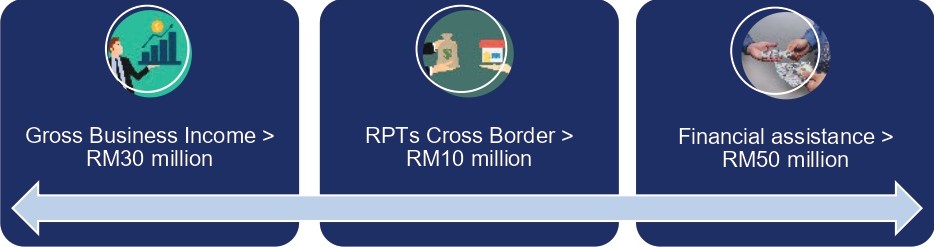
In the transfer pricing guidelines 2024, the IRBM further relaxed requirements by revising the threshold for preparing full CTPD, as follows:
Companies that does not fall within the threshold are allowed to prepare documentation that is less extensive, i.e. Minimum CTPD. A PE shall prepare its own full CTPD separately from its head office and related branches, as specified under the TP Rules.

Exemption for preparing transfer pricing documentation

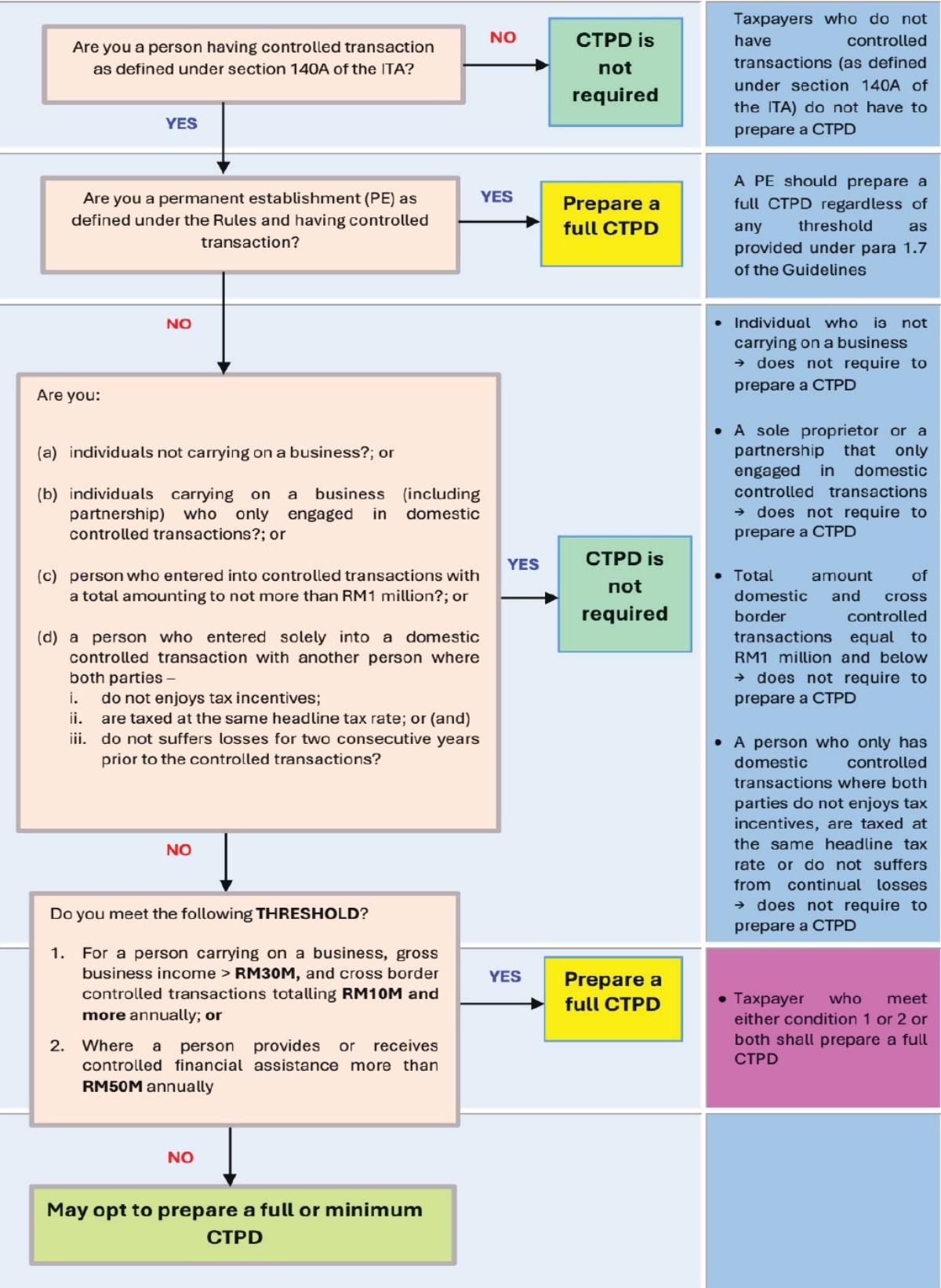
To ease the compliance burden for taxpayers, the TP Guidelines 2024 excludes the following persons (which include a company, a body of persons and a sole proprietor) from preparing a full or minimum CTPD:
Individual not carrying on a business; or
Individuals carrying on a business (including partnerships) who only engage in domestic controlled transactions; or
Person who entered into controlled transactions with a total amounting to not more than RM 1 million;
Person who entered solely into domestic controlled transactions with another person where both parties; (a) do not enjoy tax incentive (b) are taxed at the same rate; and (c) do not suffer losses for 2 consecutive years.

CTPD Flowchart

CTPD requirements

According to the TP Rules 2023, the IRBM mandates that a CTPD be brought into existence prior to the deadline for filing a Corporate Income Tax (“CIT”) return (i.e. 7 months after the financial year end of the companies, or any extended CIT return filing, in a given YA). The completion date of the TPD must be indicated on the TPD and must be provided within 14 days upon request during a tax audit. Failure to comply with this requirement may result in a penalty ranging between RM20,000 and RM100,000 for each YA under the section 113B of ITA.

Full CTPD Scope

The required contents of a comprehensive full CTPD are outlined in Paragraph 11.7, Chapter 11 of the TP Guidelines 2024, and are aligned with the requirements under the TP Rulesas follows:
a) Group worldwide organizational structure
b) Description of MNE Group businesses
c) MNE’s intangible assets
d) MNE’s intercompany financial activities
e) MNE’s financial and tax position
In the event that a master file has been prepared for the Group, it can be included as an attachment and does not have to be repeated in the report
f) Local organizational structure and company background
g) Nature of business/industry and market conditions
h) Controlled transactions
i) Pricing policies including formula adopted and sample documents to justify
j) Assumption, strategies and information regarding factors that influenced the price setting policies
k) Functions, assets and risk analysis including risk analysis framework
l) Comparability analysis
m) Selection of the transfer pricing method including basis to justify the selection
n) Application of the transfer pricing method
o) Financial information
p) Other relevant/supporting documents.

Minimal TPD Scope

Taxpayers who are eligible to prepare a minimum CTPD are subject to a reduced documentation requirements.

For minimum CTPD, the scope of controlled transactions and pricing policy is limited to key controlled transactions, which are defined as:

  1. Transactions related to the taxpayer’s principal business activity, and
  2. Transactions that, while not principal in nature, individually contribute 20% or more of the taxpayer’s operating revenue for the relevant YA.

The IRB has released a template to simplify TPD compliance and reduce administrative burden of compliance for SMEs (PIN 1/2023). Companies that fall below the threshold can choose to fill in the details requested in the minimum TPD template.

The template is a form that consists of 4 parts as follows:

Company Information

  • Company reg no.
  • Tax reference
  • Address
  • Financial period
  • Principal activity
  • Industry code/ Type of business activity

Group Information

  • Name, Country, Address and Tax No. of Ultimate, Holding Subsidiary and Affiliate Companies
  • Global and Company organization chart
  • Reporting lines

RPTs

  • Type, amount of RPT and percentage of transactions
  • Name, Country, Business activity, Tax No. and relationship of related companies involved in transaction
  • Agreement/ supporting documentation

Policy

  • Pricing policy for each type of RPT
  • Pricing basis (i.e. costs elements & profit mark-up)
  • Sample documentation
  • Comparability study

Low value adding intra-group services (“LVAS”)

The IRB has adopted a simplified approach for LVAS (though this approach is only applicable to Malaysia service providers or foreign service providers who have similarly adopted the Organisation for Economic Co-operation and Development (“OECD”) simplified approach in their jurisdiction).

The service provider shall apply a profit mark-up of 5% to all costs in the pool (expect for any pass- through costs) and the mark-up under this approach does not need to be justified by a benchmarking study. However, all relevant documents should be prepared on the simplified approach.

TP Audit Framework

The IRBM has updated its TP Audit Framework (“TPAF”) over the years to change how tax audits are done. The newest and current version is the TPAF 2025, which came out on 31 July 2025. This version replaced the 2024 Framework which was releases together with the TP Guidelines 2024 to change the way penalty surcharges are calculated for businesses.

Key takeaways of the TPTAF 2025 are as follows:
Key Takeaways Details
Year of assessment The IRB may carry out a comprehensive audit for up to six (6) YAs. However, the Yas covered to raise the assessment may be extended to seven (7) prior years of assessment, depending on the audit findings.
Basis for selection of cases Basis used in the selection of TP tax audit cases is based on:
  • Selection through risk assessment criteria for controlled transactions;
  • Restructuring of the company group; and
  • Information received from third parties including foreign tax authorities.
Audit settlement For TP tax audits that only involve related companies in Malaysia, if there are any adjustments made to any of those related companies, the offsetting adjustment for the same amount will not be automatically given to the other related parties.

The application for an offsetting adjustment must be made by the other related parties, and audits will be carried out to ensure that the application may be considered on the provisions of the Act.
Voluntary disclosure Voluntary disclosures are made after the deadline for submission of the Return Form but before the audit commences.

The information and documentation required, along with the Voluntary Disclosure Form to be submitted is set out and included in the TPTAF 2025.
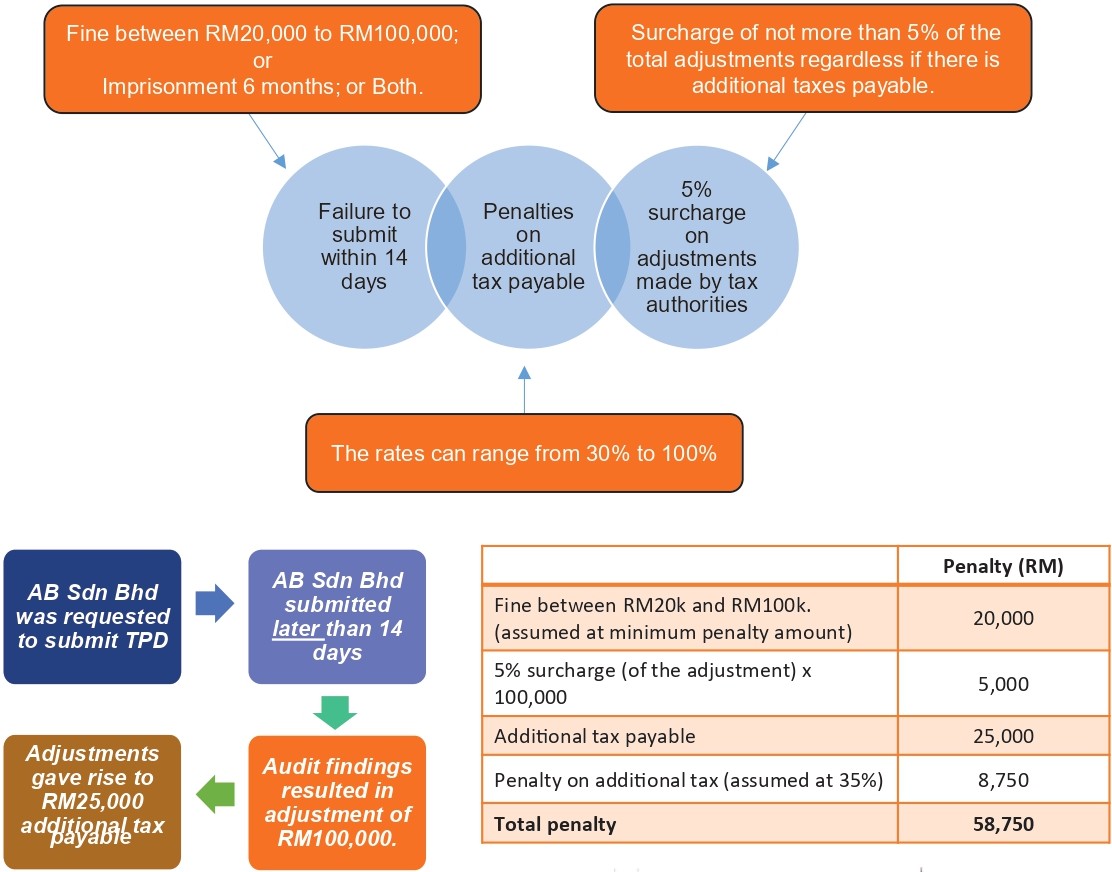
Offence, penalty and surcharge A surcharge at a rate of up to 5% on the amount of the transfer pricing adjustment may be imposed instead (0% to 4% for a voluntary disclosure). A surcharge still may be imposed even if no additional assessment is raised because the surcharge rate is imposed on the amount of the adjustment itself.

Penalty

TPTAF has established a penalty structure for the failure to submit the TPD within the required timeframe as well as for adverse audit findings.

From the year of assessment 2023, a taxpayer who fails to submit a TPD within 14 days from the date of service of a written notice has committed an offence under subsection 113B(1) of the ITA. The taxpayer may be fined not less than RM20,000.00 and not more than RM100,000.00 or imprisonment for not more than 6 months or both.

The amount of penalty that will be imposed based on the period of delay in submitting the TPD is as follows:
No Period of delay (number of days) Penalty amount
1 Up to 7 days RM20,000.00
2 More than 7 days up to 14 days RM40,000.00
3 More than 14 days up to 21 days RM60,000.00
4 More than 21 days up to 28 days RM80,000.00
5 More than 28 days RM100,000.00

Illustration on Penalties

Income Tax (Country-by-Country Reporting) Rules 2016 (“CbyCR Rules”)

The tax authorities issued the CbyCR Rules followed by the Labuan CbyCR Regulation, effective from 1 January 2017.

The Rule is applicable to MNE Groups that fulfil the following criteria:
Income Tax (CbyCR) Rules 2016
Total consolidated group revenue
  • RM 3 Billion
Constituent entities
  • Ultimate holding entity; or

  • Incorporated under the companies act 2016; or

  • Surrogate holding entity; or

  • Permanent establishment in Malaysia.

Labuan Business Activity Tax (CbyCR) Regulations 2017
Total consolidated group revenue
  • RM 3 Billion
Ultimate holding / Constituent entities
  • Labuan entity carrying on a Labuan business activity.

Timeline

The rules state that the ultimate parent (reporting entity) would have to complete the CbyC Report and submit it to the tax authorities on or before 12 months from the last day of the reporting FY (i.e. 31 December 2024 if the tax payer’s year end is 31 December 2023).

Penalty under Section 112A & 113A of the ITA and Labuan Regulations

Income Tax (CbyCR) Rules 2016 Labuan Business Activity Tax (CbyCR) Regulations 2017
Failure of submission/Incomplete and/or incorrect information provided to the DGIR:
  • Fine of not less than RM20,000 and not more than RM100,000; and/or
  • Imprisonment of not exceeding 6 months.
Failure of submission/Incomplete and/or incorrect information provided to the DGIR:
  • Fine of not exceeding RM1,000,000; and/or
  • Imprisonment of not exceeding two years.
Additionally, there is also a requirement for the Malaysian Companies to notify the tax authorities under Subrule 6(1) and 6(2) of the PU (A) 357/2016 either by disclosing the information as part of the tax returns or by submitting the manual notification form.

Malaysian parent entities and subsidiaries submitting the Form C , TR , TA , TC or TN (tax return forms, whichever is applicable) can furnish the notification by way of tax returns while companies filing Form LE & TF are required to furnish the notification using a manual notification form as follows:
Reporting entity
[Annex B1]
The reporting entity shall notify the Director General in writing if it is the ultimate holding entity on or before the last day of the FY.
Details of all Malaysian and foreign non-reporting constituent entities must be included.
Non-reporting entity
[Annex C1 & C2]
The Malaysian subsidiary must notify the Director General in writing of the identity and tax residence of the reporting entity on or before the last day of the FY.

Tax Return Form

Throughout the year from FY 2014 to FY 2022, the income tax return form has been amended to include additional disclosures as follows:

  1. Transfer Pricing Documentation and its related information

    Tax payer is to disclose its characterization, other related information and all type of transactions they are involved in with a related party and the amount.

  2. Disclosure of whether the taxpayer is subject to interest restriction under Section 140C.

    Tax authorities introduced Restriction on deductibility of interest under Section 140C of the Income Tax Act 1967, effective 1 July 2019 onwards aimed at restricting the deduction of interest expense in relation to cross border transaction. The Rules are applicable to:

    • companies who have been granted any financial assistance in a controlled transaction;
    • the total amount of any interest expense for all such financial assistance exceeds RM500,000 in the basis period.

    The maximum amount of interest that is deductible is 20% of the Tax EBITDA. The balance is allowed to be carried forward.

  3. Disclosure on CbyCR

    Tax payer is to disclose if CbyCR is relevant for the Group and fill in the relevant information of the reporting entity.

Key Take-aways

  • Tax authorities may enforce a tax audit at any time of the year.
  • Tax authorities have provided a time and cost-efficient template for SME companies to encourage
  • compliance.
  • In addition to the template, taxpayers also need to include documentation or analysis to justify that
  • the RPT is carried out at market price (i.e. comparability study)
  • It is essential for the taxpayers to indicate the completion date on the TPD.
  • Although there are exemptions for the preparation of TPD, in case of an audit, there are possibilities for
  • adjustments that will result in additional tax.
  • There is a risk of IRB imposing the 5% surcharge on adjustments on top of penalty imposed.
  • Taxpayer’s responsibility is to maintain the relevant records, documentation and calculation to justify
  • the arm’s length nature of the inter-company transactions.
  • Taxpayers need to reassess the completeness and robustness of the TPD prepared previously and
  • make amendments to the scope where necessary.
  • Taxpayers should ensure contemporaneous preparation of the TPD.
Categories
Ideas & Insights Newsletter Tax

Employee Secondment Is Free From Service Tax Subject To Certain Conditions

Newsletters

Key Takeaway

A secondment arrangement is not automatically non-taxable. Its Service Tax treatment depends on whether the applicable conditions for a genuine secondment are satisfied.

Tips

  • Review your existing employee secondment arrangements to ensure they meet the conditions under Ketetapan Umum Bil. 5/2026;
  • Identify arrangements that do not meet the prescribed conditions and assess whether Service Tax should be charged on the relevant employment services.
Under the 2024 Guide on Employment Services, employment services are generally subject to Service Tax. However, employee secondment is excluded from the scope of taxable employment services.

With the issuance of General Ruling Bil. 5/2026, Customs has now clarified what qualifies as an employee secondment. In simple terms, a secondment arrangement will not be subject to Service Tax only if all the prescribed conditions are met.

A secondment arrangement will be regarded as non-taxable services only if all of the following conditions are satisfied:

Appropriate contractual documentation

The arrangement should be supported by a formal secondment agreement or other relevant documentation evidencing the nature and terms of the secondment;

Original employer is not an employment-service provider

The original employer’s business must not be the provision of employment services, including an employment agency or professional employer organisation;

Temporary transfer

The employee is temporarily transferred to perform duties for another company for a specified period and subsequently returns to the original employer;

Continuing employment relationship

The employee remains employed by the original employer, with the employment relationship continuing throughout the secondment;

Exclusive service during secondment

During the secondment period, the employee works solely for the host company;

Control by the host company

The host company has overall control over the employee’s work and duties during the secondment; AND

Salary / allowances recovered at cost only

The host company bears the employee’s remuneration and relevant allowances, whether paid directly or indirectly, without an additional service fee, commission or mark-up.
Categories
Ideas & Insights Newsletter Tax

e- Invoice: RM3 Million Is the New Threshold!

Newsletters

Key Takeaway

e-Invoice exemption threshold increased from RM1 million to RM3 million, effective 1 September 2026.

Tips

  • Check your annual turnover/revenue against the RM3 million threshold.
  • Check ownership and group structures before relying on the exemption, particularly shareholders, holding companies, related companies and joint ventures.
The Inland Revenue Board of Malaysia (“IRBM”) issued e-Invoice Guideline Version 4.8 on 30 August 2026, replacing Version 4.7 dated 7 July 2026. The key amendments relate principally to the e-Invoice implementation timeline and the exemption threshold for taxpayers with annual turnover or revenue below RM3 million.

This represents a significant relaxation for taxpayers with turnover between RM1 million and below RM3 million, who were previously within the e-Invoice framework.

The amendments comprise changes to paragraphs 1.5 and 1.6.1(e), together with the introduction of new paragraphs 1.6.9 and 1.6.10 as below:

Implementation timeline for new businesses

Paragraph 1.5 has been amended to reflect the revised RM3 million threshold in determining the e-Invoice implementation timeline for businesses that commence operations between 2023 and 2025. Businesses that commenced operations during this period should reassess their e-Invoice implementation date based on the revised RM3 million threshold.

Exemption threshold increased

The exemption threshold has been increased from RM1 million to RM3 million.

Specific taxpayers brought into the e-Invoice requirement

This Guide further clarifies the e-Invoice treatment applicable to the following entities:

  • Statutory bodies;
  • Statutory authorities;
  • Local authorities; and
  • International organisations.

These entities are required to issue e-Invoices for goods sold or services performed from 1 July 2025 onwards.

Conditions restricting the RM3 million exemption

The exemption for taxpayers with annual turnover / revenue of less than RM3 million applies across taxpayer categories, including individuals, partnerships, companies and cooperatives. However, the exemption does not apply in certain ownership or group-structure circumstances:-

Taxpayer with annual turnover or revenue of less than RM3 million shall not be eligible for the exemption where any of the following conditions apply:

  • Non-individual shareholder
    The taxpayer has a non-individual shareholder (or equivalent) with annual turnover / revenue of RM3 million or more.
  • Subsidiary
    The taxpayer is a subsidiary of a holding company whose annual turnover / revenue is RM3 million or more.
  • Related company / joint venture
    The taxpayer has a related company or joint venture with annual turnover / revenue of RM3 million or more.