The Income Tax (TP) Rules 2023 (“2023 TP Rules”) were officially released and gazetted on 29 May 2023.The
rules were issued by the Ministry of Finance and the Inland Revenue Board of Malaysia (“IRBM”). They came
into operation starting from the Year of Assessment (“YA”) 2023 and it supersedes the rules that was released
in 2012. Significant changes were made with the intention to boost compliance and provide taxpayers with
more clarity with regards to TP compliance. Some of the important changes that affect the way TP
documentations (“TPD”) will be prepared moving forward is as follows
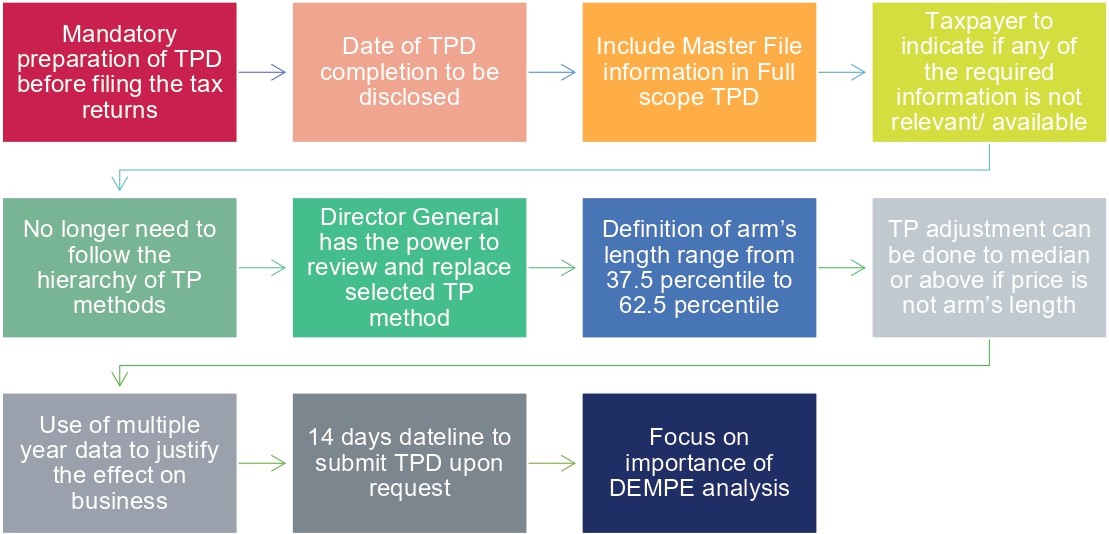
TP Rules 2023 - Detailed Description
Date of TPD
completion to be
disclosed
Include Master File
information in Full
scope TPD
Taxpayer to indicate if
any of the required
information is not
relevant/ available
No longer need to
follow the hierarchy of
TP methods
Director General has
the power to review
and replace selected
TP method
Definition of arm’s
length range from 37.5
percentile to 62.5
percentile
TP adjustment can be
done to median or
above if price is not
arm’s length
Use of multiple year
data to justify the
effect on business
14 days dateline to
submit TPD upon
request
Focus on importance
of DEMPE analysis
TP Rules 2023 – Additional Requirements
Cost contribution arrangement
When a person engages in a cost contribution arrangement with a related party to share the costs and risks of
a controlled transaction, the person should ensure that the allocation of costs for such arrangement is
comparable to how two unrelated parties would have done the allocation at arm’s length in a similar
arrangement.
Intangible property refers to an asset which is neither a physical asset nor a financial asset but such asset is
capable of being owned or controlled for use in commercial purposes, whose use or transfer would be
compensated had it occurred in a transaction between independent persons in comparable circumstances
which includes patent, invention, formula, process, design, model, plan, trade secret, know-how or marketing
intangible.
Any party that contributes to the functions above should be entitled to an arm’s length consideration,
regardless of legal ownership.
Interest on financial assistance
The TP Rule stipulates that all financial assistance is subject finance charge, discount, premium or other
consideration relating to a controlled transaction.
Any person in a controlled transaction who provides or receives financial assistance (i.e. loan, interest bearing
trade credit, advance or debt), directly or indirectly, to or from another person with or without consideration,
shall determine the arm’s length interest rate for such assistance.
On 30 December 2024, the IRBM issued the Malaysian Transfer Pricing Guidelines 2024 (“TP Guidelines 2024”),
which take effect from the YA 2023. These updated guidelines are to be read together with the Income Tax Act
1967 and the 2023 TP Rules. Key changes include expanded guidance and new requirements for
contemporaneous transfer pricing documentation (“CTPD”).
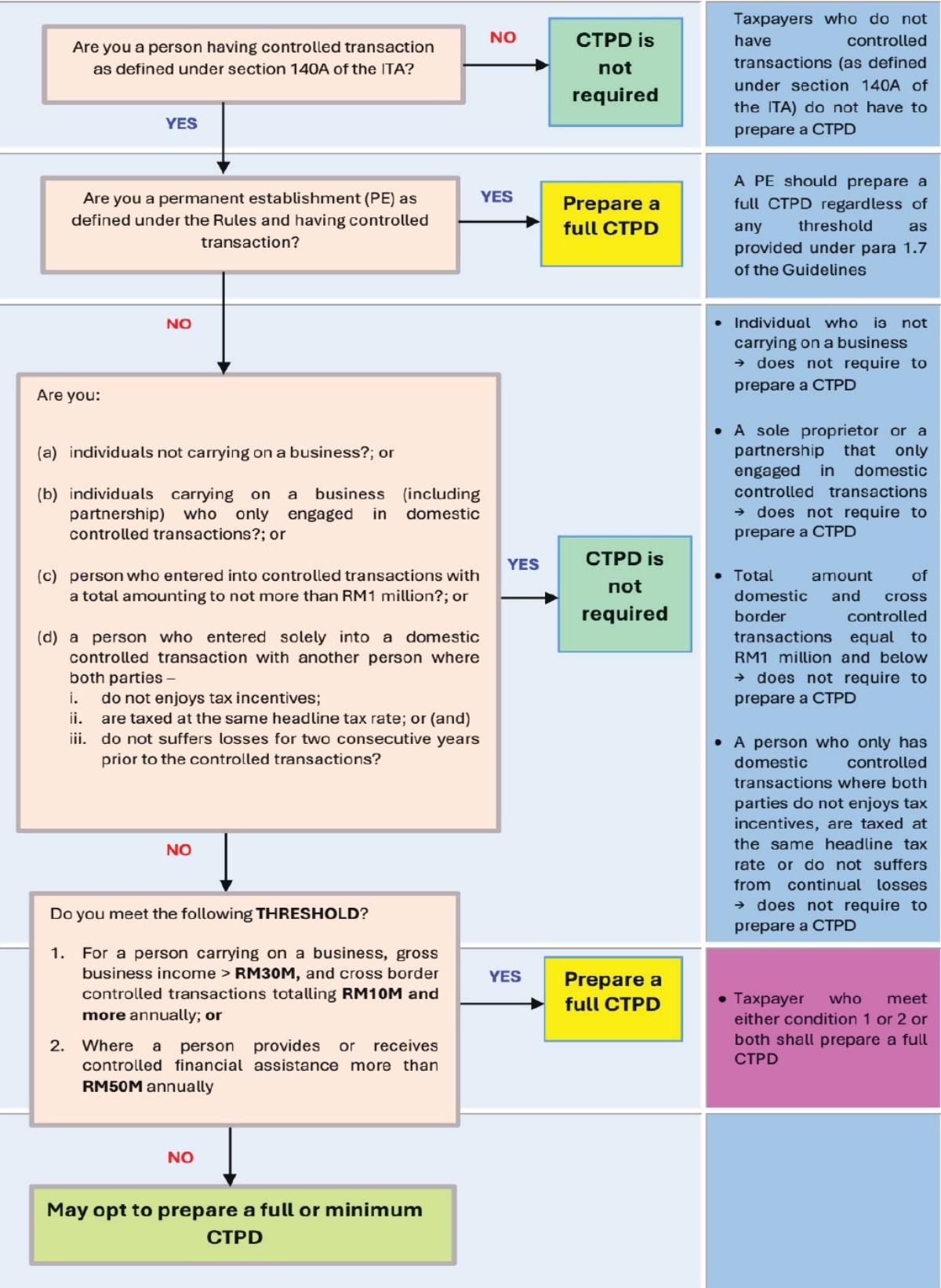
Scope for preparation of CTPD
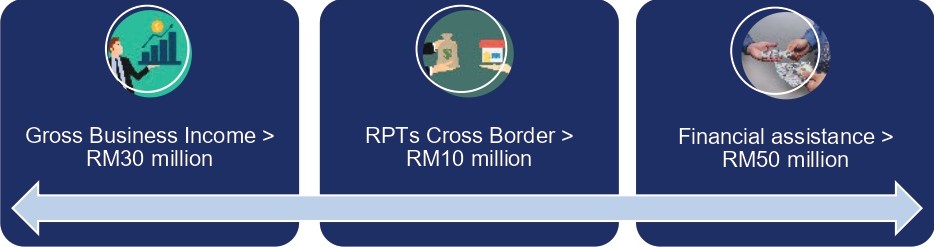
In the transfer pricing guidelines 2024, the IRBM further relaxed requirements by revising the threshold for
preparing full CTPD, as follows:
Companies that does not fall within the threshold are allowed to prepare documentation that is less extensive,
i.e. Minimum CTPD. A PE shall prepare its own full CTPD separately from its head office and related branches,
as specified under the TP Rules.
Exemption for preparing transfer pricing documentation
To ease the compliance burden for taxpayers, the TP Guidelines 2024 excludes the following persons (which
include a company, a body of persons and a sole proprietor) from preparing a full or minimum CTPD:
Individual not
carrying on a
business; or
Individuals carrying
on a business
(including
partnerships) who
only engage in
domestic controlled
transactions; or
Person who entered
into controlled
transactions with a
total amounting to
not more than RM 1
million;
Person who entered
solely into domestic
controlled
transactions with
another person
where both parties;
(a) do not enjoy tax
incentive (b) are
taxed at the same
rate; and (c) do not
suffer losses for 2
consecutive years.
According to the TP Rules 2023, the IRBM mandates that a CTPD be brought into existence prior to the
deadline for filing a Corporate Income Tax (“CIT”) return (i.e. 7 months after the financial year end of the
companies, or any extended CIT return filing, in a given YA). The completion date of the TPD must be
indicated on the TPD and must be provided within 14 days upon request during a tax audit. Failure to
comply with this requirement may result in a penalty ranging between RM20,000 and RM100,000 for each
YA under the section 113B of ITA.
The required contents of a comprehensive full CTPD are outlined in Paragraph 11.7, Chapter 11 of the TP
Guidelines 2024, and are aligned with the requirements under the TP Rulesas follows:
a) Group worldwide
organizational structure
b) Description of MNE Group businesses
c) MNE’s intangible assets
d) MNE’s intercompany financial activities
e) MNE’s financial and tax position
In the event that a master file has been prepared for the Group, it can be included as
an attachment and does not have to be repeated in the report
f) Local organizational structure and company background
g) Nature of business/industry and market conditions
h) Controlled transactions
i) Pricing policies including formula adopted and sample documents to justify
j) Assumption, strategies and information regarding factors that influenced the price setting policies
k) Functions, assets and risk analysis including risk analysis framework
l) Comparability analysis
m) Selection of the transfer pricing method including basis to justify the selection
n) Application of the transfer pricing method
o) Financial information
p) Other relevant/supporting documents.
Low value adding intra-group services (“LVAS”)
The IRB has adopted a simplified approach for LVAS (though this approach is only applicable to
Malaysia service providers or foreign service providers who have similarly adopted the Organisation for
Economic Co-operation and Development (“OECD”) simplified approach in their jurisdiction).
The service provider shall apply a profit mark-up of 5% to all costs in the pool (expect for any pass-
through costs) and the mark-up under this approach does not need to be justified by a benchmarking
study. However, all relevant documents should be prepared on the simplified approach.
The IRBM has updated its TP Audit Framework (“TPAF”) over the years to change how tax audits are
done. The newest and current version is the TPAF 2025, which came out on 31 July 2025. This version
replaced the 2024 Framework which was releases together with the TP Guidelines 2024 to change the
way penalty surcharges are calculated for businesses.
Key takeaways of the TPTAF 2025 are as follows:
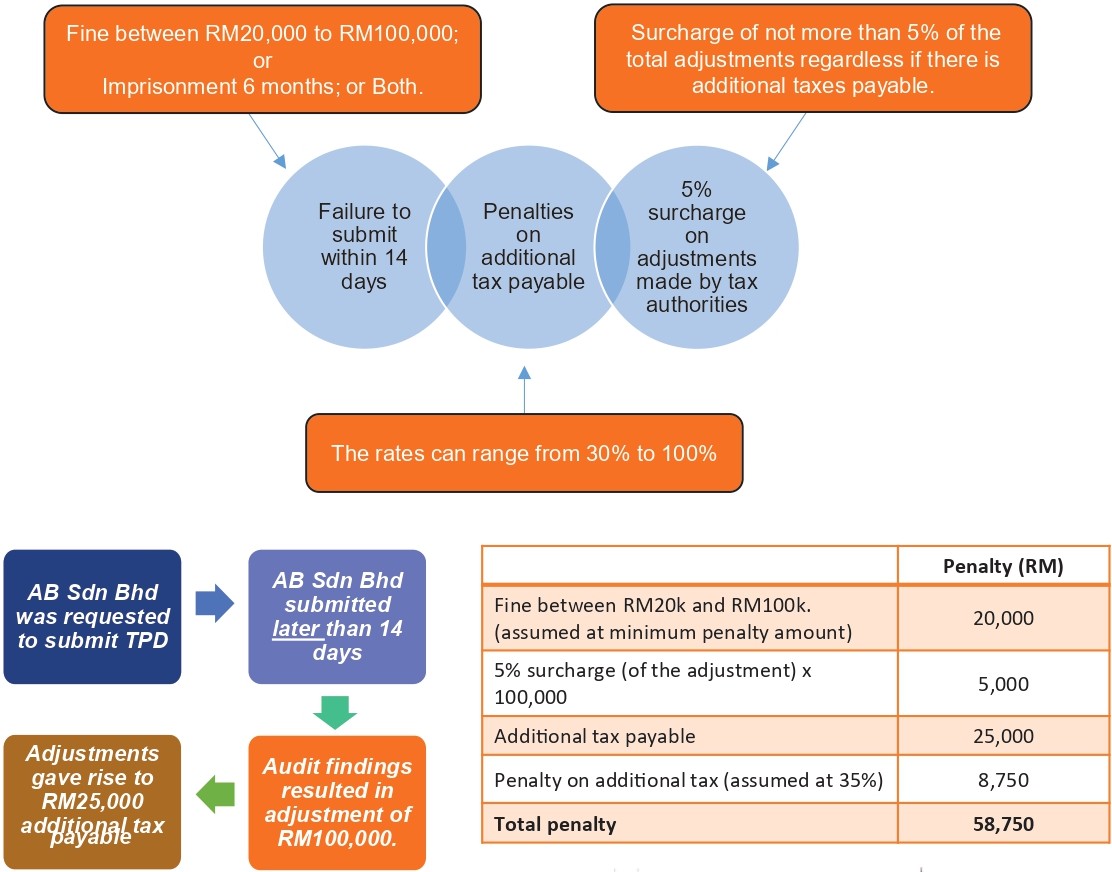
TPTAF has established a penalty structure for the failure to submit the TPD within the required timeframe
as well as for adverse audit findings.
From the year of assessment 2023, a taxpayer who fails to submit a TPD within 14 days from the date of
service of a written notice has committed an offence under subsection 113B(1) of the ITA. The taxpayer
may be fined not less than RM20,000.00 and not more than RM100,000.00 or imprisonment for not more
than 6 months or both.
The amount of penalty that will be imposed based on the period of delay in submitting the TPD is as
follows:
Illustration on Penalties
Income Tax (Country-by-Country Reporting) Rules 2016 (“CbyCR Rules”)
The tax authorities issued the CbyCR Rules followed by the Labuan CbyCR Regulation, effective from 1
January 2017.
The Rule is applicable to MNE Groups that fulfil the following criteria:
Income Tax (CbyCR) Rules 2016
Total consolidated group revenue
Labuan Business Activity Tax (CbyCR) Regulations 2017
Total consolidated group revenue
Ultimate holding / Constituent entities
The rules state that the ultimate parent (reporting entity) would have to complete the CbyC Report and submit
it to the tax authorities on or before 12 months from the last day of the reporting FY (i.e. 31 December 2024 if
the tax payer’s year end is 31 December 2023).
Penalty under Section 112A & 113A of the ITA and Labuan Regulations
Additionally, there is also a requirement for the Malaysian Companies to notify the tax authorities under Subrule 6(1) and 6(2) of the PU (A) 357/2016 either by disclosing the information as part of the tax returns or by submitting the manual notification form.
Malaysian parent entities and subsidiaries submitting the Form C , TR , TA , TC or TN (tax return forms, whichever is applicable) can furnish the notification by way of tax returns while companies filing Form LE & TF are required to furnish the notification using a manual notification form as follows: