Categories
Ideas & Insights Newsletter Tax

RM3 Million e-Invoice Exemption Threshold: Eligible Taxpayers May Discontinue e-Invoice Issuance Without Prior HASiL Approval

Newsletters

Key Takeaway

  • The e-Invoice implementation threshold has been increased from RM1 million to RM3 million, effective 1 September 2026.
  • Taxpayers who have already started e-Invoicing but now qualify for the exemption may stop issuing e-Invoices without applying to HASiL.
The Inland Revenue Board of Malaysia (“IRBM”) has clarified that businesses with annual turnover or revenue below RM3 million that satisfy the prescribed exemption criteria will not be subject to compliance action or penalties, even if they have not issued e-Invoices from their applicable implementation date. The clarification was provided in the latest e-Invoice Frequently Asked Questions (FAQ) issued by IRBM dated 4th August 2026.

Immediate Cessation of e-Invoice Without Prior Approval

Taxpayers who qualify for the e-Invoice exemption but have already commenced e-Invoice implementation may discontinue issuing e-Invoices immediately. Importantly, taxpayers are not required to submit a separate application to IRBM or obtain prior approval to cease e-Invoice implementation.

Under the latest clarification, taxpayers with annual turnover or revenue below RM3 million who satisfy the exemption conditions set out in Section 1.6.10 of the e-Invoice Guideline are eligible for the exemption.

Voluntary e-Invoice Implementation Remains an Option

Businesses that qualify for the exemption are not prohibited from continuing with e-Invoice implementation. Taxpayers may voluntarily continue issuing e-Invoices if they consider it beneficial for their business operations, accounting processes or broader digitalisation efforts.

Tax Incentives

The e-Invoice FAQs also summarise the tax incentives available to eligible taxpayers in relation to e-Invoice implementation, including Accelerated Capital Allowance (ACA) incentives. The applicable incentives, together with their legislative reference or status, key details, and effective period, are set out in a table.

Special Voluntary Disclosure Programme (“SVDP”)

FAQs No 123–133 provide taxpayers with greater certainty on the practical application of the e-Invoice SVDP, particularly in relation to historical rectification, the 72-hour cancellation rule, incorrect classifications, subsequent disclosures, consolidated e-Invoices, group entities and third-party service providers. Taxpayers should consider undertaking a review of their historical e-Invoice transactions to identify any outstanding non-compliance and, where appropriate, regularise the position during the SVDP period ending 31 December 2027.
Categories
Ideas & Insights Newsletter Transfer Pricing

Transfer Pricing Rules 2023 & 2024 Transfer Pricing Guidelines

Newsletters

TP Rules 2023

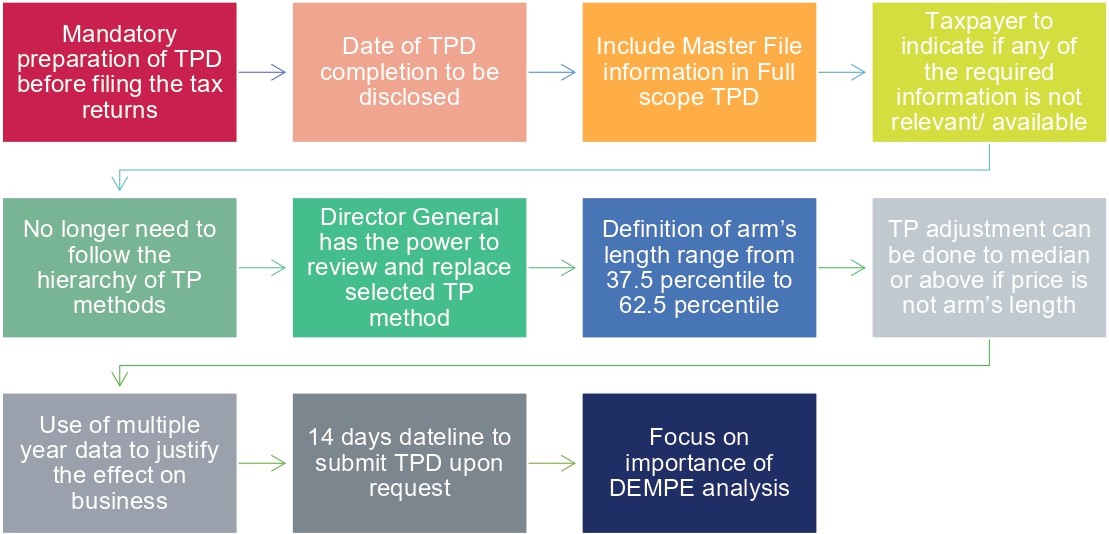
The Income Tax (TP) Rules 2023 (“2023 TP Rules”) were officially released and gazetted on 29 May 2023.The rules were issued by the Ministry of Finance and the Inland Revenue Board of Malaysia (“IRBM”). They came into operation starting from the Year of Assessment (“YA”) 2023 and it supersedes the rules that was released in 2012. Significant changes were made with the intention to boost compliance and provide taxpayers with more clarity with regards to TP compliance. Some of the important changes that affect the way TP documentations (“TPD”) will be prepared moving forward is as follows

TP Rules 2023 - Detailed Description

Mandatory preparation of TPD before filing the tax returns

Date of TPD completion to be disclosed
  • “Contemporaneous” TPD must be prepared before the filing of the tax return for the relevant year of assessment.
  • While this is not a new requirement, it has now been made clearer in the rules and it allows the Tax Authorities to penalize taxpayers who did not prepare the TPD in a timely manner.
  • The requirement to include the date of completion in the TPD is in line with the Tax Authorities’ intention to increase compliance and to have concrete written evidence as to whether the TPD was prepared before or after the filing of the tax returns.
Include Master File information in Full scope TPD
Taxpayer to indicate if any of the required information is not relevant/ available
  • Contemporaneous Full TPD must now include additional information on the MNE Group that is relevant to the taxpayer’s business in Malaysia. Alternatively, the taxpayer can attach the Master file prepared by the Group or ultimate holding company with the Local TPD.
  • Previously this requirement was only applicable for Group of Companies that is required to submit the Country-by-Country Report.
  • In the absence of any Master File, the local taxpayer will have to request for this information from the ultimate parent company to include in the Local TPD.
  • The Tax Authorities have also included a detailed list of information and/or documentation to be included or attached in the Local TPD.
  • Based on the above, taxpayers must indicate in the TPD if any of the information or documents required are not applicable to the taxpayers. Failure to do so will result in an incomplete TPD.
No longer need to follow the hierarchy of TP methods
Director General has the power to review and replace selected TP method
  • Previously the Guidelines requests taxpayers to select the TP method on a hierarchy basis which means that the Comparable Uncontrolled Price (“CUP”) must be considered first before the other methods on the list.
  • However, now the requirement is that the best method is selected and can be supported by explanation and sufficient reasoning to justify the selection.
  • There is also a clause that allows the Director General to disregard the taxpayer’s selected method and replace with a different method if they are the opinion that it is not the most appropriate method.
Definition of arm’s length range from 37.5 percentile to 62.5 percentile
TP adjustment can be done to median or above if price is not arm’s length
  • The Tax Authorities general practice or expectation previously was for taxpayers to achieve results that is above the median of the benchmarking analysis or to make an adjustment to the median of the benchmarking.
  • The new rules have included a definition for the arm’s length range from 37.5 percentile to 62.5 percentile and that Companies’ who fall within the range may be regarded as arm’s length.
  • However, taxpayers should be aware that the Director General has the power to make any TP adjustment to the median or any other point above median and within the arm’s length range if there is reason to believe that the comparable companies selected is not suitable.
Use of multiple year data to justify the effect on business
  • The Director General may allow for use of data from the review period and prior years if it can be proven that life cycles or business cycles of the property/services are not impacted by the conditions of commercial or financial relations between associated persons.
  • However, this can only be used to assist in the selection of comparable and not for the use of multiple year averages.
14 days dateline to submit TPD upon request
  • Previously this dateline was only included in the TP Guidelines. It has not been included in the Rules as well.
  • Failure to submit the TPD within 14 days will result in penalties even if there is no adjustments made or additional taxes payable.
Focus on importance of DEMPE analysis
  • Emphasizes the importance of the Development, Enhancement, Maintenance, Protection and Exploitation (“DEMPE”) analysis for intangible property.
  • Any party that contributes to the functions above should be entitled to an arm’s length consideration, regardless of legal ownership.

TP Rules 2023 – Additional Requirements

Intra-group Services

Intra-group services are those services rendered between associated persons. A person should be able to exhibit that the intra-group services have been rendered and the provision of such services generates an economic benefit or commercial value to his business and the charge for the intra-group services is justified.

Intra-group services shall be disregarded if it involves:

  • Shareholder or custodial activities
  • Duplicative services
  • Services that provide incidental benefits or passive association benefits
  • On-call services

Cost contribution arrangement

When a person engages in a cost contribution arrangement with a related party to share the costs and risks of a controlled transaction, the person should ensure that the allocation of costs for such arrangement is comparable to how two unrelated parties would have done the allocation at arm’s length in a similar arrangement.

Intangible property

Intangible property refers to an asset which is neither a physical asset nor a financial asset but such asset is capable of being owned or controlled for use in commercial purposes, whose use or transfer would be compensated had it occurred in a transaction between independent persons in comparable circumstances which includes patent, invention, formula, process, design, model, plan, trade secret, know-how or marketing intangible.

Any party that contributes to the functions above should be entitled to an arm’s length consideration, regardless of legal ownership.

Interest on financial assistance

The TP Rule stipulates that all financial assistance is subject finance charge, discount, premium or other consideration relating to a controlled transaction.

Any person in a controlled transaction who provides or receives financial assistance (i.e. loan, interest bearing trade credit, advance or debt), directly or indirectly, to or from another person with or without consideration, shall determine the arm’s length interest rate for such assistance.

TP Guidelines 2024

On 30 December 2024, the IRBM issued the Malaysian Transfer Pricing Guidelines 2024 (“TP Guidelines 2024”), which take effect from the YA 2023. These updated guidelines are to be read together with the Income Tax Act 1967 and the 2023 TP Rules. Key changes include expanded guidance and new requirements for contemporaneous transfer pricing documentation (“CTPD”).

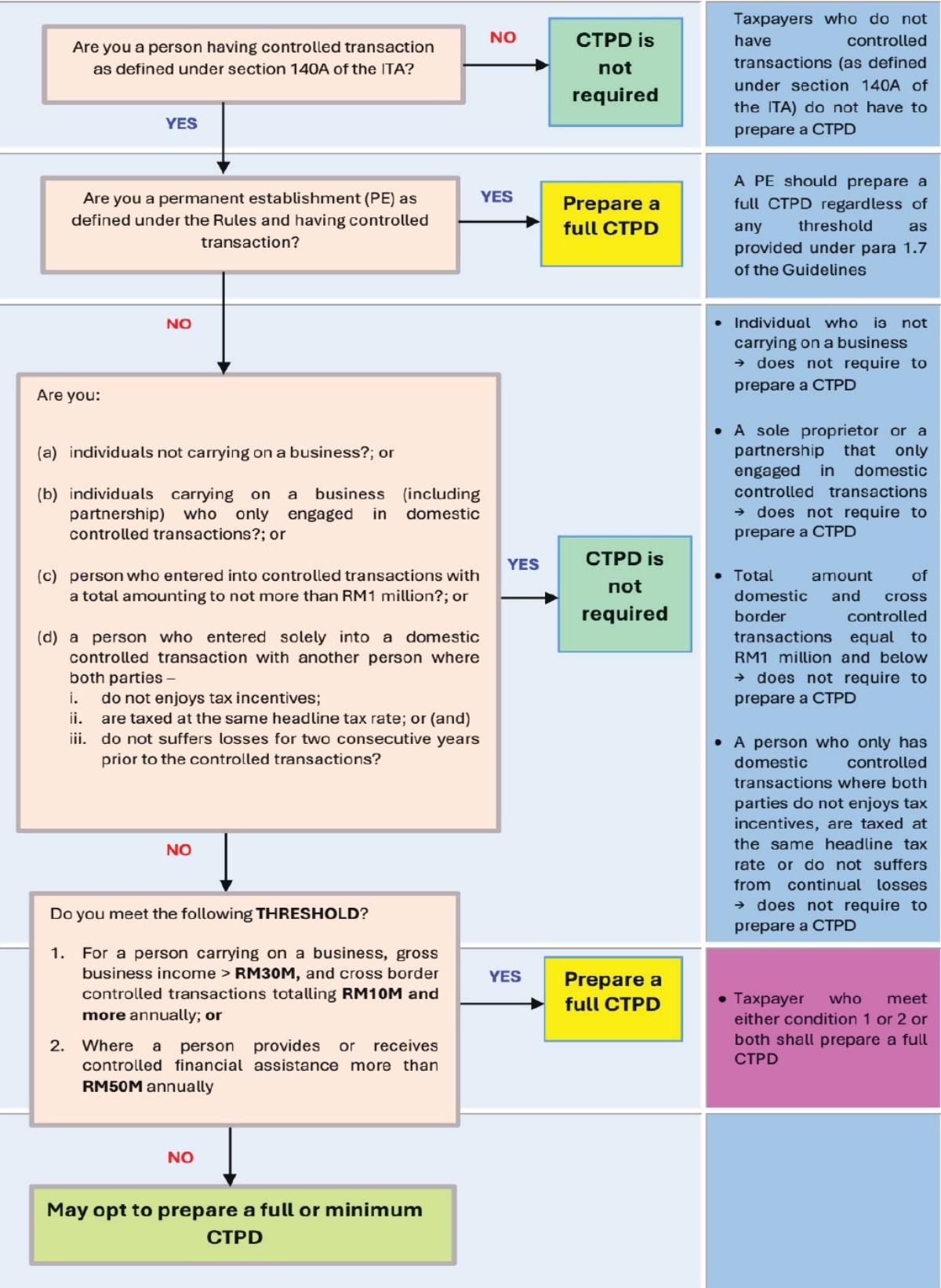
Scope for preparation of CTPD

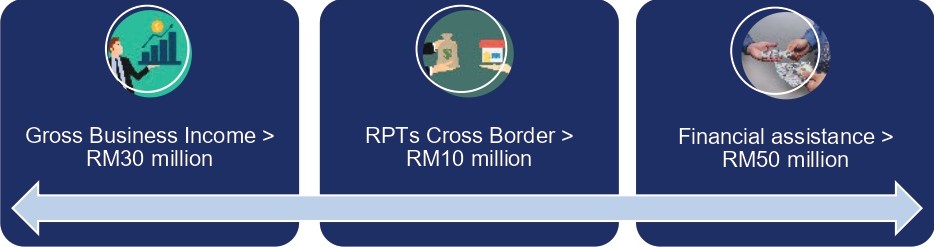
In the transfer pricing guidelines 2024, the IRBM further relaxed requirements by revising the threshold for preparing full CTPD, as follows:
Companies that does not fall within the threshold are allowed to prepare documentation that is less extensive, i.e. Minimum CTPD. A PE shall prepare its own full CTPD separately from its head office and related branches, as specified under the TP Rules.

Exemption for preparing transfer pricing documentation

To ease the compliance burden for taxpayers, the TP Guidelines 2024 excludes the following persons (which include a company, a body of persons and a sole proprietor) from preparing a full or minimum CTPD:
Individual not carrying on a business; or
Individuals carrying on a business (including partnerships) who only engage in domestic controlled transactions; or
Person who entered into controlled transactions with a total amounting to not more than RM 1 million;
Person who entered solely into domestic controlled transactions with another person where both parties; (a) do not enjoy tax incentive (b) are taxed at the same rate; and (c) do not suffer losses for 2 consecutive years.

CTPD Flowchart

CTPD requirements

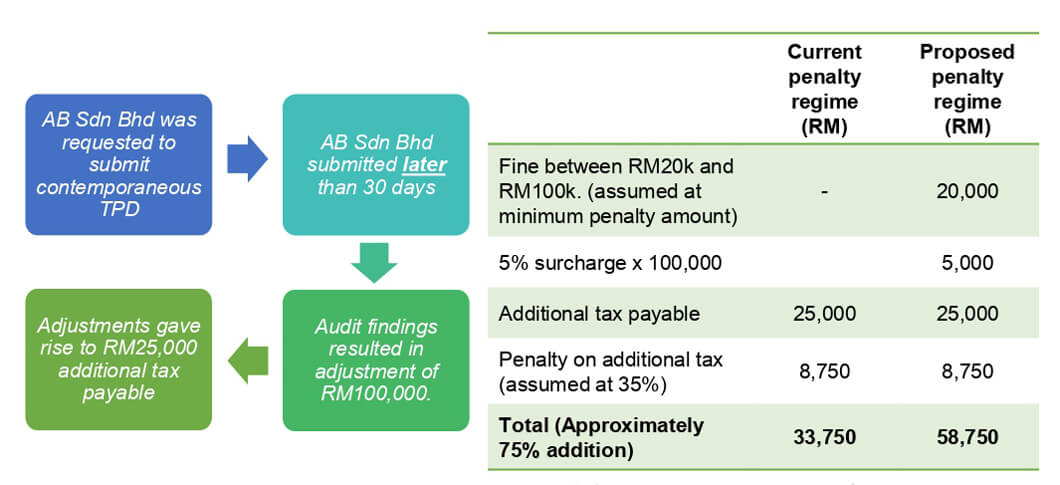
According to the TP Rules 2023, the IRBM mandates that a CTPD be brought into existence prior to the deadline for filing a Corporate Income Tax (“CIT”) return (i.e. 7 months after the financial year end of the companies, or any extended CIT return filing, in a given YA). The completion date of the TPD must be indicated on the TPD and must be provided within 14 days upon request during a tax audit. Failure to comply with this requirement may result in a penalty ranging between RM20,000 and RM100,000 for each YA under the section 113B of ITA.

Full CTPD Scope

The required contents of a comprehensive full CTPD are outlined in Paragraph 11.7, Chapter 11 of the TP Guidelines 2024, and are aligned with the requirements under the TP Rulesas follows:
a) Group worldwide organizational structure
b) Description of MNE Group businesses
c) MNE’s intangible assets
d) MNE’s intercompany financial activities
e) MNE’s financial and tax position
In the event that a master file has been prepared for the Group, it can be included as an attachment and does not have to be repeated in the report
f) Local organizational structure and company background
g) Nature of business/industry and market conditions
h) Controlled transactions
i) Pricing policies including formula adopted and sample documents to justify
j) Assumption, strategies and information regarding factors that influenced the price setting policies
k) Functions, assets and risk analysis including risk analysis framework
l) Comparability analysis
m) Selection of the transfer pricing method including basis to justify the selection
n) Application of the transfer pricing method
o) Financial information
p) Other relevant/supporting documents.

Minimal TPD Scope

Taxpayers who are eligible to prepare a minimum CTPD are subject to a reduced documentation requirements.

For minimum CTPD, the scope of controlled transactions and pricing policy is limited to key controlled transactions, which are defined as:

  1. Transactions related to the taxpayer’s principal business activity, and
  2. Transactions that, while not principal in nature, individually contribute 20% or more of the taxpayer’s operating revenue for the relevant YA.

The IRB has released a template to simplify TPD compliance and reduce administrative burden of compliance for SMEs (PIN 1/2023). Companies that fall below the threshold can choose to fill in the details requested in the minimum TPD template.

The template is a form that consists of 4 parts as follows:

Company Information

  • Company reg no.
  • Tax reference
  • Address
  • Financial period
  • Principal activity
  • Industry code/ Type of business activity

Group Information

  • Name, Country, Address and Tax No. of Ultimate, Holding Subsidiary and Affiliate Companies
  • Global and Company organization chart
  • Reporting lines

RPTs

  • Type, amount of RPT and percentage of transactions
  • Name, Country, Business activity, Tax No. and relationship of related companies involved in transaction
  • Agreement/ supporting documentation

Policy

  • Pricing policy for each type of RPT
  • Pricing basis (i.e. costs elements & profit mark-up)
  • Sample documentation
  • Comparability study

Low value adding intra-group services (“LVAS”)

The IRB has adopted a simplified approach for LVAS (though this approach is only applicable to Malaysia service providers or foreign service providers who have similarly adopted the Organisation for Economic Co-operation and Development (“OECD”) simplified approach in their jurisdiction).

The service provider shall apply a profit mark-up of 5% to all costs in the pool (expect for any pass- through costs) and the mark-up under this approach does not need to be justified by a benchmarking study. However, all relevant documents should be prepared on the simplified approach.

TP Audit Framework

The IRBM has updated its TP Audit Framework (“TPAF”) over the years to change how tax audits are done. The newest and current version is the TPAF 2025, which came out on 31 July 2025. This version replaced the 2024 Framework which was releases together with the TP Guidelines 2024 to change the way penalty surcharges are calculated for businesses.

Key takeaways of the TPTAF 2025 are as follows:
Key Takeaways Details
Year of assessment The IRB may carry out a comprehensive audit for up to six (6) YAs. However, the Yas covered to raise the assessment may be extended to seven (7) prior years of assessment, depending on the audit findings.
Basis for selection of cases Basis used in the selection of TP tax audit cases is based on:
  • Selection through risk assessment criteria for controlled transactions;
  • Restructuring of the company group; and
  • Information received from third parties including foreign tax authorities.
Audit settlement For TP tax audits that only involve related companies in Malaysia, if there are any adjustments made to any of those related companies, the offsetting adjustment for the same amount will not be automatically given to the other related parties.

The application for an offsetting adjustment must be made by the other related parties, and audits will be carried out to ensure that the application may be considered on the provisions of the Act.
Voluntary disclosure Voluntary disclosures are made after the deadline for submission of the Return Form but before the audit commences.

The information and documentation required, along with the Voluntary Disclosure Form to be submitted is set out and included in the TPTAF 2025.
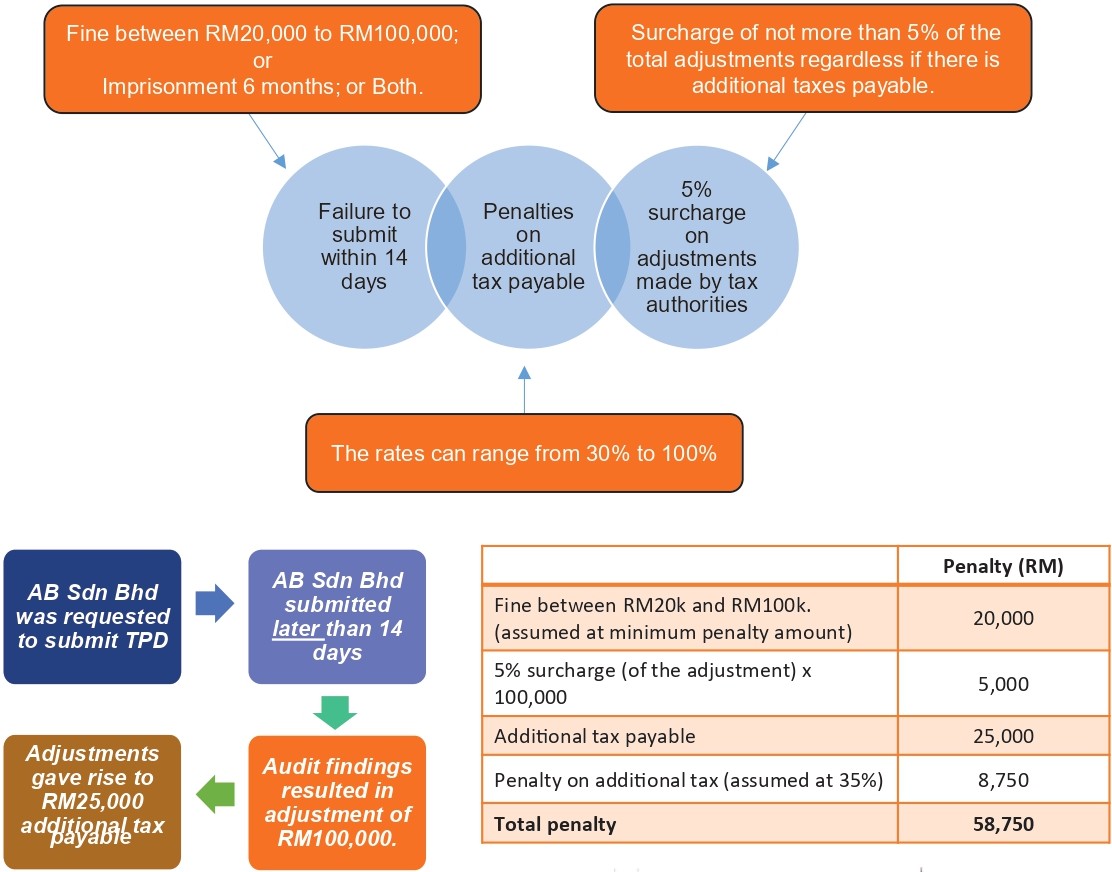
Offence, penalty and surcharge A surcharge at a rate of up to 5% on the amount of the transfer pricing adjustment may be imposed instead (0% to 4% for a voluntary disclosure). A surcharge still may be imposed even if no additional assessment is raised because the surcharge rate is imposed on the amount of the adjustment itself.

Penalty

TPTAF has established a penalty structure for the failure to submit the TPD within the required timeframe as well as for adverse audit findings.

From the year of assessment 2023, a taxpayer who fails to submit a TPD within 14 days from the date of service of a written notice has committed an offence under subsection 113B(1) of the ITA. The taxpayer may be fined not less than RM20,000.00 and not more than RM100,000.00 or imprisonment for not more than 6 months or both.

The amount of penalty that will be imposed based on the period of delay in submitting the TPD is as follows:
No Period of delay (number of days) Penalty amount
1 Up to 7 days RM20,000.00
2 More than 7 days up to 14 days RM40,000.00
3 More than 14 days up to 21 days RM60,000.00
4 More than 21 days up to 28 days RM80,000.00
5 More than 28 days RM100,000.00

Illustration on Penalties

Income Tax (Country-by-Country Reporting) Rules 2016 (“CbyCR Rules”)

The tax authorities issued the CbyCR Rules followed by the Labuan CbyCR Regulation, effective from 1 January 2017.

The Rule is applicable to MNE Groups that fulfil the following criteria:
Income Tax (CbyCR) Rules 2016
Total consolidated group revenue
  • RM 3 Billion
Constituent entities
  • Ultimate holding entity; or

  • Incorporated under the companies act 2016; or

  • Surrogate holding entity; or

  • Permanent establishment in Malaysia.

Labuan Business Activity Tax (CbyCR) Regulations 2017
Total consolidated group revenue
  • RM 3 Billion
Ultimate holding / Constituent entities
  • Labuan entity carrying on a Labuan business activity.

Timeline

The rules state that the ultimate parent (reporting entity) would have to complete the CbyC Report and submit it to the tax authorities on or before 12 months from the last day of the reporting FY (i.e. 31 December 2024 if the tax payer’s year end is 31 December 2023).

Penalty under Section 112A & 113A of the ITA and Labuan Regulations

Income Tax (CbyCR) Rules 2016 Labuan Business Activity Tax (CbyCR) Regulations 2017
Failure of submission/Incomplete and/or incorrect information provided to the DGIR:
  • Fine of not less than RM20,000 and not more than RM100,000; and/or
  • Imprisonment of not exceeding 6 months.
Failure of submission/Incomplete and/or incorrect information provided to the DGIR:
  • Fine of not exceeding RM1,000,000; and/or
  • Imprisonment of not exceeding two years.
Additionally, there is also a requirement for the Malaysian Companies to notify the tax authorities under Subrule 6(1) and 6(2) of the PU (A) 357/2016 either by disclosing the information as part of the tax returns or by submitting the manual notification form.

Malaysian parent entities and subsidiaries submitting the Form C , TR , TA , TC or TN (tax return forms, whichever is applicable) can furnish the notification by way of tax returns while companies filing Form LE & TF are required to furnish the notification using a manual notification form as follows:

Reporting entity
[Annex B1]
The reporting entity shall notify the Director General in writing if it is the ultimate holding entity on or before the last day of the FY.
Details of all Malaysian and foreign non-reporting constituent entities must be included.
Non-reporting entity
[Annex C1 & C2]
The Malaysian subsidiary must notify the Director General in writing of the identity and tax residence of the reporting entity on or before the last day of the FY.

Tax Return Form

Throughout the year from FY 2014 to FY 2022, the income tax return form has been amended to include additional disclosures as follows:

  1. Transfer Pricing Documentation and its related information

    Tax payer is to disclose its characterization, other related information and all type of transactions they are involved in with a related party and the amount.

  2. Disclosure of whether the taxpayer is subject to interest restriction under Section 140C.

    Tax authorities introduced Restriction on deductibility of interest under Section 140C of the Income Tax Act 1967, effective 1 July 2019 onwards aimed at restricting the deduction of interest expense in relation to cross border transaction. The Rules are applicable to:

    • companies who have been granted any financial assistance in a controlled transaction;
    • the total amount of any interest expense for all such financial assistance exceeds RM500,000 in the basis period.

    The maximum amount of interest that is deductible is 20% of the Tax EBITDA. The balance is allowed to be carried forward.

  3. Disclosure on CbyCR

    Tax payer is to disclose if CbyCR is relevant for the Group and fill in the relevant information of the reporting entity.

Key Take-aways

  • Tax authorities may enforce a tax audit at any time of the year.
  • Tax authorities have provided a time and cost-efficient template for SME companies to encourage
  • compliance.
  • In addition to the template, taxpayers also need to include documentation or analysis to justify that
  • the RPT is carried out at market price (i.e. comparability study)
  • It is essential for the taxpayers to indicate the completion date on the TPD.
  • Although there are exemptions for the preparation of TPD, in case of an audit, there are possibilities for
  • adjustments that will result in additional tax.
  • There is a risk of IRB imposing the 5% surcharge on adjustments on top of penalty imposed.
  • Taxpayer’s responsibility is to maintain the relevant records, documentation and calculation to justify
  • the arm’s length nature of the inter-company transactions.
  • Taxpayers need to reassess the completeness and robustness of the TPD prepared previously and
  • make amendments to the scope where necessary.
  • Taxpayers should ensure contemporaneous preparation of the TPD.
Categories
Ideas & Insights Newsletter Tax

Employee Secondment Is Free From Service Tax Subject To Certain Conditions

Newsletters

Key Takeaway

A secondment arrangement is not automatically non-taxable. Its Service Tax treatment depends on whether the applicable conditions for a genuine secondment are satisfied.

Tips

  • Review your existing employee secondment arrangements to ensure they meet the conditions under Ketetapan Umum Bil. 5/2026;
  • Identify arrangements that do not meet the prescribed conditions and assess whether Service Tax should be charged on the relevant employment services.
Under the 2024 Guide on Employment Services, employment services are generally subject to Service Tax. However, employee secondment is excluded from the scope of taxable employment services.

With the issuance of General Ruling Bil. 5/2026, Customs has now clarified what qualifies as an employee secondment. In simple terms, a secondment arrangement will not be subject to Service Tax only if all the prescribed conditions are met.

A secondment arrangement will be regarded as non-taxable services only if all of the following conditions are satisfied:

Appropriate contractual documentation

The arrangement should be supported by a formal secondment agreement or other relevant documentation evidencing the nature and terms of the secondment;

Original employer is not an employment-service provider

The original employer’s business must not be the provision of employment services, including an employment agency or professional employer organisation;

Temporary transfer

The employee is temporarily transferred to perform duties for another company for a specified period and subsequently returns to the original employer;

Continuing employment relationship

The employee remains employed by the original employer, with the employment relationship continuing throughout the secondment;

Exclusive service during secondment

During the secondment period, the employee works solely for the host company;

Control by the host company

The host company has overall control over the employee’s work and duties during the secondment; AND

Salary / allowances recovered at cost only

The host company bears the employee’s remuneration and relevant allowances, whether paid directly or indirectly, without an additional service fee, commission or mark-up.
Categories
Ideas & Insights Newsletter Tax

e- Invoice: RM3 Million Is the New Threshold!

Newsletters

Key Takeaway

e-Invoice exemption threshold increased from RM1 million to RM3 million, effective 1 September 2026.

Tips

  • Check your annual turnover/revenue against the RM3 million threshold.
  • Check ownership and group structures before relying on the exemption, particularly shareholders, holding companies, related companies and joint ventures.
The Inland Revenue Board of Malaysia (“IRBM”) issued e-Invoice Guideline Version 4.8 on 30 August 2026, replacing Version 4.7 dated 7 July 2026. The key amendments relate principally to the e-Invoice implementation timeline and the exemption threshold for taxpayers with annual turnover or revenue below RM3 million.

This represents a significant relaxation for taxpayers with turnover between RM1 million and below RM3 million, who were previously within the e-Invoice framework.

The amendments comprise changes to paragraphs 1.5 and 1.6.1(e), together with the introduction of new paragraphs 1.6.9 and 1.6.10 as below:

Implementation timeline for new businesses

Paragraph 1.5 has been amended to reflect the revised RM3 million threshold in determining the e-Invoice implementation timeline for businesses that commence operations between 2023 and 2025. Businesses that commenced operations during this period should reassess their e-Invoice implementation date based on the revised RM3 million threshold.

Exemption threshold increased

The exemption threshold has been increased from RM1 million to RM3 million.

Specific taxpayers brought into the e-Invoice requirement

This Guide further clarifies the e-Invoice treatment applicable to the following entities:

  • Statutory bodies;
  • Statutory authorities;
  • Local authorities; and
  • International organisations.

These entities are required to issue e-Invoices for goods sold or services performed from 1 July 2025 onwards.

Conditions restricting the RM3 million exemption

The exemption for taxpayers with annual turnover / revenue of less than RM3 million applies across taxpayer categories, including individuals, partnerships, companies and cooperatives. However, the exemption does not apply in certain ownership or group-structure circumstances:-

Taxpayer with annual turnover or revenue of less than RM3 million shall not be eligible for the exemption where any of the following conditions apply:

  • Non-individual shareholder
    The taxpayer has a non-individual shareholder (or equivalent) with annual turnover / revenue of RM3 million or more.
  • Subsidiary
    The taxpayer is a subsidiary of a holding company whose annual turnover / revenue is RM3 million or more.
  • Related company / joint venture
    The taxpayer has a related company or joint venture with annual turnover / revenue of RM3 million or more.
Categories
Ideas & Insights Newsletter Tax

Employment Service: Fees Subject Service Tax While Salary Recoveries, Disbursement Costs & Statutory & Regulatory Charges Are Excluded

Newsletters

Key Takeaway

Service Tax applies only to employment or management fees, excluding disbursement expenses.

Tips

To ensure that fees and disbursements are clearly stated and properly supported by documentation.
The Royal Malaysian Customs Department (“RMCD”) issued a new announcement on 13 August 2026, clarifying the Service Tax treatment of employment services, particularly with regard to employment / management fees and disbursement expenses.

Under the RMCD’s clarification:

  • Employment or Management fees
    Service Tax applies to the fees charged for the provision of employment services and management services;
  • Disbursement Costs
    Costs or expenses incurred on behalf of a customer and subsequently recovered on a pass-through (disbursement) basis are not subject to Service Tax;
  • Statutory and regulatory charges
    Fees, duties, levies, taxes, fines, penalties and other similar payments imposed under written laws and paid on behalf of the customer are treated as disbursements. These amounts should not be included in the taxable value for Service Tax purposes.
Categories
Ideas & Insights Newsletter Tax

Employment Contracts of RM3,000 and Below No Longer Require IRBM Endorsement

Newsletters

Key Takeaway

Not every employment-related document needs to be stamped.

Tips

Check the employment contract and related documents against the applicable category to determine whether stamp duty payment, stamping, or endorsement is required.
The Inland Revenue Board of Malaysia (“IRBM”) issued a media release on 7 August 2026 providing important guidance on stamp duty for employment contracts, including the applicable exemptions and endorsement requirements under the Stamp Act 1949.

At a Glance: Do You Need to Stamp Your Employment Documents

Employment Document / Situation What Employers Need to Do
Employment contract with monthly salary of RM3,000 or below. No stamping and no endorsement required.
Employment contract with monthly salary above RM3,000. Stamp and endorse only the main/master employment contract.
Supporting employment documents relating to the same employment. No stamping and no endorsement required.
Instrument covered under the “General Exemption” category. No stamp duty payable, but endorsement is required.
For more details, please click the link below:
Media Release dated 07 August 2026
Categories
Ideas & Insights Newsletter Tax

e-Invoicing Updates

Newsletters

Key Takeaway

  • Phase 4 e-Invoicing: 12-Month Transition Period
  • Special Concession for the Construction Materials Sector

A. 12 - MONTH TRANSITIONAL PERIOD (1 JANUARY – 31 DECEMBER 2026)

As you are aware, businesses with annual turnover between RM1 million and RM5 million fall under Phase 4 of the e-Invoice programme and is required to fully implement e-invoicing effective from 1 January 2026.

With reference to the Media Release issued by Inland Revenue Board of Malaysia (“IRBM”) dated 5th January 2026, the Government has announced a 12-month interim relaxation period for businesses under Phase 4, extending the previously announced 6-month timeline.

With that, the interim relaxation period for such businesses has been extended to 1 January 2026 to 31 December 2026. What is important to note is that this is not a postponement of the requirement for businesses under Phase 4 to be fully-compliant with the e-Invoice system – it is merely a deferment. During this period, businesses under Phase 4 will still be required to comply with the conditions spelt out in the IRBM’s e-Invoice Specific Guidelines, for e-Invoice compliance during the interim relaxation period.
During the interim relaxation period which spans 1 January 2026 to 31 December 2026, business under Phase 4 are permitted to do the following:

a. Issue consolidated e-Invoices for all activities and transactions, including for industries or activities listed under Section 3.7 of the Specific Guidelines on e-Invoices. Issuance of consolidated e-Invoices is also permitted even if there is an e-Invoice request from the buyer;

b. Issue consolidated self-billing e-Invoices for all self-billing situations as outlined under Section 8.3 of the Specific Guidelines on e-Invoices; and

c. Allow any transaction description to be entered in the “Product or Service Description” field.

During the transition period, the IRBM has announced that they will not impose penalties for any non-compliance with the e-Invoice requirements, provided that the taxpayer complies with the rules stated above.

B. SPECIAL CONCESSION: CONSTRUCTION MATERIALS SECTOR

Effective 1 January 2026, the government also agreed to allow taxpayers from the wholesale and retail of construction materials sector to issue consolidated e-Invoices. However, e-Invoices are still mandatory if they involve transactions exceeding RM10,000 or more or when there is a request from the buyer to obtain an e-Invoice.
For more details please refer to the link below:-
Media Release from IRBM dated 5 Jan 2026

How We Can Help

At ShineWing, we provide a wide spectrum of services to support your successful implementation of the e-Invoice system in Malaysia and compliance of its laws and guidelines, among which, include the following:

Regulatory Guidance

Supporting businesses in interpreting and complying with IRBM’s e-invoicing requirements, including IRBM guidelines, statutory deadlines, and documentation standards to ensure full tax compliance..

Ongoing Support

Providing continuous maintenance, governance, and updates to keep e-invoicing solutions aligned with evolving IRBM regulations, while offering training and advisory to sustain compliance and operational efficiency.
Should you have any questions or require any assistance on the above, please do not hesitate to drop us an email or call us.
Categories
Ideas & Insights Newsletter Tax

Malaysia Budget 2022 Highlights

Malaysia Budget 2022 Highlights: Strengthening Recovery, Building Resilience and Driving Reforms

Key Takeaway

  • Effective from 1 January 2022, income derived from foreign sources and received in Malaysia by Malaysian tax residents will be subject to income tax
  • For YA 2022, Cukai Makmur, a special one-off tax to be imposed on companies with taxable income of more than 100 million ringgit
  • Unutilised business losses to be carried forward for 10 consecutive YAs
  • Additional Reinvestment Allowance will be extended for 2 years until YA 2024
  • Effective from 1 January 2022, RPGT rate of an individual citizen, permanent resident and other than a company for disposal in the 6th year and onwards be reduced from 5% to 0%.
On 29 October 2021, our Finance Minister, YB Senator Tengku Datuk Seri Utama Zafrul Tengku Abdul Aziz tabled the 2022 National Budget with the theme, ‘Keluarga Malaysia, Makmur Sejahtera’ as Malaysia enters the recovery phase of COVID-19 and makes preparation to revitalise its economy.

Numerous tax measures were introduced revolving around the three key pillars of the 2022 National Budget, namely Strengthening Recovery, Building Resilience and Driving Reforms.

This edition of our Tax Alert is prepared based on the 2022 National Budget speech and a follow-up edition will be issued to cover key tax proposals and updates, after the Finance Bill is issued.

Key Tax Proposals

Affecting Individuals

  • Tax relief on costs associated with the adoption of self-funded booster vaccines.
  • The scope for individual income tax relief for full medical check-up expenses is expanded to cover the cost of check-up or consultation service related to mental health from registered psychiatrist, clinical psychologist and counsellor.
  • In line with the new norm and work from home practices, the special individual income tax relief of up to RM2,500 on the purchase of mobile phone, computer and tablet be extended until 31 December 2022.
  • The limit of individual income tax relief for up-skilling and self-enhancement course fees will be increased from RM1,000 to RM2,000 and extended to year of assessment 2023. In addition, those who undertake courses with any professional bodies will be eligible for a tax relief of up to RM7,000. Approved courses include professional courses in accounting, finance and environmental, social and governance (ESG)-related.
  • Tax relief of up to RM4,000 for Employees’ Provident Fund (EPF) contributors is expanded to include voluntary contributions, such as those who are self-employed in the gig economy including pensionable civil servants.
  • Tax relief limit will be increased from RM250 to RM350 and the scope of relief for Social Security Organisation (SOCSO) contributions will also be expanded to cover employee contributions through the Employment Insurance Scheme (EIS).
  • Tax relief of up to RM3,000 for fees paid to registered child care centre or kindergarten is extended until the year of assessment 2023.
  • Income tax exemption on recognised e-sports tournament prize money.
  • Special individual income tax relief for domestic tourism expenses up to RM1,000 be extended until year of assessment 2022.
  • Tax relief up to RM2,500 on expenses related to cost of installation, rental, purchasing including hire-purchase equipment or subscription fees for EV charging facilities.
  • Income tax is imposed to residents in Malaysia on income derived from foreign sources and received in Malaysia from 1 January 2022.
  • Tax relief for deferred annuity premium payment be extended until the year of assessment 2025 (to be in line with the extension of the income tax relief for contribution in Private Retirement Scheme (PRS)).

Key Tax Proposals

Affecting Corporates and Businesses

  • Tax deduction to employers on costs associated with the adoption of self-funded booster vaccines.
  • Double tax deduction to companies that provide scholarships to students in institutions of higher learning:
    1. the scope of qualifying studies be expanded to all fields of study at the Technical and Vocational, Diploma, Degree including Master’s and Doctorate; and
    2. the tax incentive be extended for 4 years from the year of assessment 2022 to the year of assessment 2025.
  • Tax incentive for the Structured Internship Program is extended until the year of assessment 2025 and this incentive is also expanded for students in the Master’s Degree, Professional Certificate and Malaysian Skills Certificate Levels 1 and 2.
  • Tax deduction of up to RM300,000 on the cost of renovating and refurbishing business premises is extended until 31 December 2022.
  • For manufacturing and manufacturing-related service companies registered under Safe@Work, a further tax deduction of up to RM50,000 on rental expenses of employees’ accommodation premises will be extended until 31 December 2022.
  • Special tax deduction to the owners of buildings or business premises who provide rental reduction to tenants of at least 30% from the original rate be extended until June 2022.
  • Treatment of accumulated unabsorbed business losses:
    1. the current unabsorbed business losses that can be carried forward from year of assessment 2019 onwards be extended from a maximum period of 7 consecutive years of assessment to a maximum period of 10 consecutive years of assessment; and
    2. the accumulated unabsorbed losses up to the year of assessment 2018 that can be carried forward until the year of assessment 2025 be extended until the year of assessment 2028.
  • The Additional Reinvestment Allowance (RA) provided for the year of assessment 2020 to year of assessment 2022 be extended for 2 years until year of assessment 2024 for existing companies in Malaysia that have exhausted RA and Special RA eligibility. Such extension will make up the total period of Additional RA to 5 years.
  • Income tax exemption for organizers of arts and cultural activities as well as international sports and recreational competitions is extended for 3 years, ie. from the year of assessment 2023 until year of assessment 2025.
  • Income tax exemption on all income of Social Enterprises up to 3 years of assessment based on the validity period of accreditation approved by the Joint Accreditation Committee by the Ministry of Entrepreneur and Cooperative Development and Yayasan Hasanah.
  • One-off tax known as Cukai Makmur, companies with taxable income up to the first 100 million ringgit will be subject to income tax at the rate of 24 percent and the remaining taxable income will be subject to income tax at the rate of 33 percent for the year of assessment 2022.
  • Income tax is imposed to residents in Malaysia on income derived from foreign sources and received in Malaysia from 1 January 2022.
  • Micro, Small and Medium Enterprises (MSMEs) with a paid-up capital of RM2.5 million and below with annual sales turnover not exceeding RM50 million will enjoy income tax rebate of up to RM20,000 for each year of assessment, for the first 3 years of assessment. The establishment and operational period for new MSMEs including MSMEs that perform business activities through online platform be extended to 31 December 2022 .
  • Tax incentives for activities under Digital Ecosystem Acceleration Scheme (DESAC) is expanded as follows:
    1. Digital Technology Provider
      1. New company
        Income tax rate of 0% to 10% for up to 10 years.
      2. Existing company that diversifies in new service activities or new service segments
        Income tax rate of 10% for up to 10 years.
    2. Digital Infrastructure Provider
      Investment Tax Allowance (ITA) of 100% on capital expenditure for qualifying activities for up to 10 years which can be set-off against up to 100% of statutory income.
      (For application received by Malaysian Investment Development Authority (MIDA) from 30 October 2021 to 31 December 2025.)
  • Double tax deduction on operating expense of Anchor companies that developed local vendors under the Vendor Development Programme (VDP) and signed the Memorandum of Understanding (MoU) with the Ministry of International Trade and Industry (MITI) or the Ministry of Entrepreneur Development and Cooperatives (MEDAC) are reviewed as follows:
    1. deductions for qualifying operating expenses be increased up to RM500,000 per year of assessment;
    2. the tax incentive be extended for 5 years for anchor companies that have signed MoU with MEDAC; and
    3. deductions are given for 3 consecutive years of assessment. (For MoU signed between anchor companies and MEDAC from 1 January 2021 to 31 December 2025.)
  • The scope on the purchase of qualifying green assets and green services qualifying for Green Technology Tax Incentives be expanded to include Rainwater Harvesting System (RHS) projects, verified by the Malaysian Green Technology Corporation (MGTC). To be eligible for Green Investment Tax Allowance (GITA) or Green Investment Tax Exemption (GITE), applications must be received by MIDA from 1 January 2022 to 31 December 2023.
  • Tax incentive for individual income tax at a flat rate of 15% given to non-resident individuals holding key positions in companies investing in new strategic investments in Malaysia is extended for 1 year (for applications received by MIDA until 31 December 2022).

Key Tax Proposals

Indirect Tax

  • 100% sales tax exemption on CKD passenger vehicles and 50% on CBU including SUV and MPV extended for six months until 30 June 2022.
  • 100% stamp duty exemption on restructuring or rescheduling of loan/financing agreement extended to 31 December 2022.
  • Exemption on entertainment duty for entertainment activities in all Federal Territories until 31 December 2022. State authorities are similarly advised to provide duty exemption on entertainment activities to support the recovery of this sector.
  • Full exemption on import duty, excise duty and sales tax exemptions on electric vehicles (EVs). Road tax exemptions of up to 100% will also be given to the vehicle owners.
  • The rate of stamp duty on contract notes is increased from 0.1% to 0.15% and the stamp duty limit of RM200 for each related contract note is abolished. At the same time, brokerage services related to the trading of shares listed on Bursa Malaysia be exempted from service tax.
  • Sales tax be imposed on goods not exceeding RM500 from abroad sold online by seller and sent to consumers in Malaysia via air courier service.
  • Service tax is levied on delivery services provided by service providers including e-Commerce platforms except food and beverage delivery services and logistics services.
  • The Special Voluntary Recognition Program of the Royal Malaysian Customs Department was introduced in phases with a penalty remission incentive of 100 per cent for the first phase and a penalty remission of 50 per cent for the second phase. Tax remission will also be considered in certain cases.
  • For P2P financing made through P2P financing platform registered and recognised by the Securities Commission (SC), 100% stamp duty exemption on P2P loan/financing agreement between MSMEs and investors for P2P loan/financing agreement executed from 1 January 2022 to 31 December 2026.
  • Extension of stamp duty exemption of one year for Micro, Small and Medium Enterprises (MSMEs) that carry out merger or acquisition scheme on instruments executed on the following documents:
      1. contracts or agreements for the sale or lease of property (land, buildings, machinery and equipment);
      2. instrument of transfer and memorandum of understanding;
      3. loan or financing agreements; and
      4. the first rental agreement.
    for application of merger or acquisition received by the Ministry of Entrepreneur Development and Cooperatives from 1 July 2021 to 30 June 2022 and instruments executed until 31 December 2022.
  • Tourism tax exemption be extended for 1 year, from 1 January 2022 to 31 December 2022.

Key Tax Proposals

Real Property Gains Tax (RPGT)

  • RPGT rate on gains from the disposal of real property and shares in real property company by an individual citizen, permanent resident and other than a company in the 6th year and onwards be reduced from 5% to 0%.

Tax Administration

  • Deferment of income tax instalment payments for MSMEs for six months until 30 June 2022.
  • All businesses are allowed to amend the estimated income tax payable on the 11th month before 31 October 2022.
  • The use of tax identification numbers (or TINs) will be implemented from 2022 to broaden the income tax base.
Company Taxes In Malaysia
Need More Info ?

Speak with our friendly team today!

Categories
Ideas & Insights Newsletter Transfer Pricing

Transfer Pricing Requirements And New Penalties in Malaysia

Transfer Pricing Requirements And New Penalties in Malaysia

Key Takeaway

  • Transfer Pricing Documentation is to be prepared annually
  • Changes in Form C disclosure items for related party transactions, interest expenses paid to related companies and CbyCR notification
  • CbyC Rules are applicable for companies with consolidated revenue of more than RM3 billion
  • New penalty rates have been introduced
This is a summary of the Transfer Pricing Requirements in Malaysia

Transfer Pricing Guidelines (“TPG”)

The 2012 TPG superseded the Guidelines previously issued in year 2003, and was intended to provide detailed guidance to taxpayers on how to comply with the requirements of the law under Section140A of Income Tax Act 1967 and the TP Rules 2012. The 2012 TPG is applicable to:
  • Controlled transactions between associated persons, where at least one party is assessable or chargeable to tax in Malaysia; and
  • Applies to both cross-border transactions and domestic related party transactions. The TPG need not be applied to domestic controlled transactions if it can be proven that any TP adjustments will not alter the total tax payable by both parties.
The guidelines reinforces that companies involved in related party transactions in Malaysia should prepare a TP documentation for the relevant year of assessment. While the TP documentation has to be prepared, it does not need to be submitted unless requested by the tax authorities. Companies who fall below this threshold may opt to prepare a limited scope TP documentation instead of a full scope TP documentation.
  • Companies with gross income more than RM25 million, and the total amount of related party transactions more than RM15 million; OR
  • Companies with financial assistance by related parties more than RM50 million.
A full scope report may consists of the following:
  1. Organizational structure
  2. Nature of business/industry and market conditions
  3. Controlled transactions
  4. Pricing policies
  5. Assumption, strategies and information regarding factors that influenced the price setting policies
  6. Comparability, functional and risk analysis
  7. Selection of the transfer pricing method
  8. Application of the transfer pricing method
  9. Financial information
  10. Other relevant/supporting documents

A simplified TP documentation consists of items (a), (c) and (d) as detailed below. Taxpayer is allowed to apply any method other than the five methods described in the TPG provided it results in arm’s length outcomes.

(a) Organizational Structure

  1. the taxpayer’s worldwide organizational and ownership structure covering all associated persons whose transactions directly or indirectly affect the pricing of the documented transactions; and
  2. a description of the management structure of the local entity, a local organization chart, and a description of the individuals to whom local management reports and the country(ies) in which such individuals maintain their principal offices.

(b) Controlled Transactions

  1. description of details of the property or services to which transaction relates; any intangible rights or property attached thereto, the participants, the scope, timing, frequency, type and value of the controlled transactions (including all relevant related party dealings in relevant geographic markets);
  2. names and addresses of all associated persons, with details of the relationship with each such associated person;
  3. the nature, terms (including prices) and conditions of transactions (where applicable) entered into with each associated person and the quantum and value of each transaction;
  4. an overview description of the business, as well as a functional analysis of all associated persons with whom the taxpayer has transacted;
  5. all commercial agreements setting forth the terms and conditions of transactions with associated persons as well as with third parties; and
  6. a record of any forecasts, budgets or any other financial estimates prepared by the person for the business as a whole and for each division or product separately.

(c) Pricing Policies

Details of pricing policy for each type of controlled transaction shall include:
  1. the formula adopted, including anticipated profit margin/mark-up and cost component;
  2. how the formula is applied;
  3. who determine the pricing policy & how often is the policy being revised;
  4. sample of documents to support the pricing policy; and
  5. comparability study to ensure the arm’s length price.

Income Tax (Country-by-Country Reporting) Rules 2016 (“CbyCR Rules”)

In 2017, the tax authorities issued the CbyCR Rules followed by the Labuan CbyCR Regulation, effective from 1 January 2017 and is applicable to MNE Groups with total consolidated group revenue of at least RM 3 billion. The rules state that the ultimate parent (reporting entity) would have to complete the CbyC Report and submit it to the tax authorities on or before 12 months from the last day of the reporting FY (i.e. 31 December 2021 if the tax payer’s year end is 31 December 2020).

Additionally, there is also a requirement for the Malaysian Companies to notify the tax authorities under Subrule 6(1) and 6(2) of the PU (A) 357/2016 either by disclosing the information as part of the tax returns or by submitting the manual notification form.

Malaysian parent entities and subsidiaries submitting the Form C , TR , TA , TC or TN (tax return forms, whichever is applicable) can furnish the notification by way of tax returns while companies filing Form LE & TF are required to furnish the notification using a manual notification form as follows:
Type of entity
Details
Reporting entity
[Annex B1]
The reporting entity shall notify the Director General in writing if it is the ultimate holding entityon or before the last day of the reporting FY (i.e. 31 December 2021 if the tax payer’s year end is 31 December 2021). Notification will have to include details of all Malaysian and foreign non-reporting constituent entities (Annex B1)
Non-reporting entity
[Annex C1 & C2]
The Malaysian subsidiary does not have to submit the CbyCR but they shall notify the Director General in writing of the identity and tax residence of the reporting entityon or before the last day of the reporting FY (i.e. 31 December 2021 if the tax payer’s year end is 31 December 2021). There are two types of notification for non- reporting entity as follows:

a. Notification for non-reporting entities whose reporting entity is in Malaysia
b. Notification for non-reporting entities whose reporting entity is outside Malaysia

Tax Return Form

Throughout the year from FY 2014 to FY 2021, the income tax return form has been amended to include additional disclosures as follows:
  1. Disclosure on whether tax payers carry out controlled transactions under Section 139 and 140A Tax payer is to disclose all type of transactions they are involved in with a related party and the amount. Tax payer would also have to declare if TP documentation have been prepared.
  2. Disclosure of whether the taxpayer is subject to interest restriction under Section 140C.
    Tax authorities introduced Restriction on deductibility of interest under Section 140C of the Income Tax Act 1967, effective 1 July 2019 onwards aimed at restricting the deduction of interest expense in relation to cross border transaction. The Rules are applicable to:
    • companies who have been granted any financial assistance in a controlled transaction;
    • the total amount of any interest expense for all such financial assistance exceeds RM500,000 in the basis period.
    The maximum amount of interest that is deductible is 20% of the Tax EBITDA. The balance is allowed to be carried forward.
  3. Disclosure on CbyCR
    Tax payer is to disclose if CbyCR is relevant for the Group and fill in the relevant information of the reporting entity.

Transfer Pricing Penalties and Power to Disregard Structures

Failure to furnish contemporaneous Transfer Pricing documentation

With the introduction of Section 113B of the ITA, any person who fails to furnishing a contemporaneous TPD shall be liable to the following:
  1. Fine of not less than RM20,000 and not more than RM100,000; or
  2. Imprisonment for a term not exceeding six (6) months; or
  3. Both.
    1. The new section also empowers the Director General to impose a penalty as stated in (a) if taxpayer is not prosecuted for failure to furnish TP contemporaneous documentation. Taxpayers can appeal on the decision with the Special Commissioners of Income Tax but the burden of proof is on the taxpayers.

5% surcharge on Transfer Pricing adjustments

Under Section 140A (3C), the Director General may impose a surcharge of not more than 5% of the total transfer pricing adjustments regardless if there is any additional taxes payable by the taxpayers. Any surcharge imposed shall be treated as collection tax and would not be treated as a tax payable under any other provision within the ITA.

Power to disregard structure in controlled transactions

Under S140A (3A) and (3B), the Director General will be empowered to disregard any related party transaction structure adopted by the company if he is of the opinion that:
  1. The economic substance of that transaction differs from its form; or
  2. The commercial reality of that transaction differs from the arrangement which would have been adopted by an independent party.
In these circumstances, the Director General will be allowed to make adjustments to the structure to reflect the structure that would have been adopted in a third party arrangement.

Failure to comply (after adjustments have ben issued)

Penalties will be imposed under subsection 113(2) and the TP Audit Framework 2019. The rates can range from 30% to 100% depending on whether the TP documentation is prepared contemporaneously in accordance with the requirements and submitted within 14 days.

Illustration on Penalties

Illustration on Penalties

Transfer Pricing Audit Framework 2019

For Companies who fail to comply, penalties will be imposed under subsection 113(2) of Income Tax Act 1967 (“ITA”) and the TP Audit Framework 2019. The rates from the framework are as follows, divided between normal cases and voluntary disclosure cases (“VD”):
Condition
Penalty Rate
(Normal Case)

Penalty Rate
(VD)

Understatement or omission of income
100%
100%
Taxpayer did not prepare TP documentation

50%

NA

Taxpayer has prepared and submitted the TP documentation with the VD but not in accordance to the requirements; OR;Taxpayer has prepared a comprehensive and good quality TP documentation but failed to submit within timeline provided.

30%

20%

Taxpayer has prepared and submitted a comprehensive and good quality TP documentation with the VD in accordance to the requirements; OR; Taxpayer has prepared a comprehensive and good quality TP documentation and submitted within timeline provided.

0%

0%
Categories
Ideas & Insights Newsletter Tax

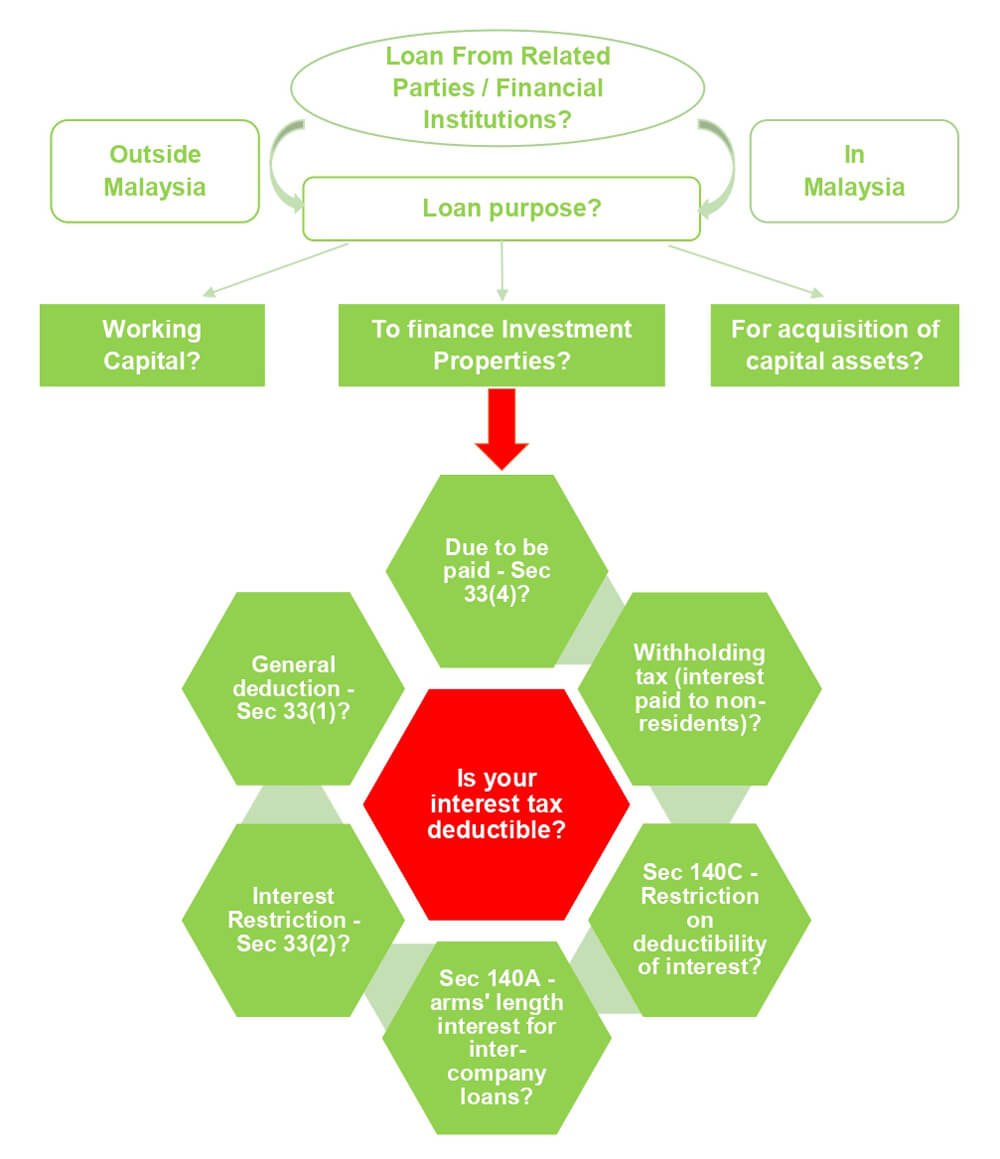
Is Your Interest Tax Deductible?

Is Your Interest Tax Deductible?

Key Takeaway

  • Deduction rules on interest expenses incurred on loan or borrowings taken for business.
  1. Borrowing is very important for the businesses. However, the source of borrowing whether is local or overseas; the parties to whom we borrowed from; the purposes of and use for the borrowings will affect the deductibility of the interest.
  2. Therefore, the rules on interest deductions (borrowing which generate interest expenses) can be complex.

Is Your Interest Tax Deductible?

Interest Tax Graph