

Categories
Featured Ideas & Insights Publications Tax

Why Labuan?

Why Labuan?

If your business models may optimise use of offshore structure, so why might an onshore investment if it carries lesser advantages as compared to offshore investment? The Labuan company is only taxed at 3% on its audited profit.

TAX BENEFITS

1. Corporate Tax 3%

The Labuan Business Activity Tax (Requirements for Labuan Business Activity) Regulation 2021 has been gazetted on 22 November 2021 and are deemed to have come into operation on 1 January 2019, a Labuan company carrying on a Labuan business activity is only subject to tax at the rate of 3% of net profit PROVIDED that it has fulfilled the requirement of the number of full time employees and an amount of annual operating expenditure as specified in the Schedule below:
Labuan Company Carrying on a Labuan Business Activity
Minimum Number of Full Time Employees in Labuan
Minimum Amount of Annual Operating Expenditure in Labuan (RM)
Labuan Insurer, Labuan reinsurer, Labuan takaful operator or Labuan retakaful operator

3

200,000

Labuan underwriting manager or Labuan underwriting takaful manage
4

100,000

Labuan insurance manager or Labuan takaful manager
4
100,000
Labuan insurance broker or Labuan takaful broker

2

100,000

Labuan captive insurer or Labuan captive takaful –
  1. Labuan first party captive insurer or Labuan first party captive takaful; or
  2. Labuan third party captive insurer or Labuan third party captive takaful.

2

2

100,000

100,000

Labuan bank, Labuan investment bank, Labuan Islamic bank or Labuan Islamic investment bank

3

200,000

Labuan trust company

3

120,000
Labuan leasing company or Labuan Islamic leasing company
  1. 10 or less related Labuan leasing companies or Labuan Islamic leasing companies;
  2. 11 to 20 related Labuan leasing companies or Labuan Islamic leasing companies;
  3. 21 to 30 related leasing companies or Labuan Islamic leasing companies;
  4. More than 30 related Labuan leasing companies or Labuan Islamic leasing companies

2 per group


3 per group


4 per group


Increase of 1 employee for every additional 10 related companies or Labuan Islamic leasing companies;

100,000 for each Labuan leasing company or Labuan Islamic leasing companies;

Labuan credit token company or Labuan Islamic credit token company

2

100,000
Labuan development finance company or Labuan Islamic development finance company

2

100,000

Labuan building credit company or Labuan Islamic factoring company

2

100,000
Labuan factoring company or Labuan Islamic factoring company

2

100,000

Labuan money broker or Labuan Islamic factoring company

2

100,000
Labuan fund manager

2

100,000

Labuan securities license or Labuan Islamic securities license

2

100,000
Labuan fund administrator

2

100,000

Labuan company management
  • provision of treasury processing services and such other services as defined in Section 129 of the Labuan Financial Services and Securities Act 2010.

2

100,000

Labuan International Financial Exchange

2

120,000

Self-regulatory organisation or Islamic self-regulation organisation

2

120,000
Labuan entity that carries on any one or more of the following business activity:
  1. administrative services – services pertaining to employee management, payroll management, property management, human resource management, financial planning, contract or subcontract management, facilities management or proposal management.*
  2. accounting services – services pertaining to recording, analysing, summarizing or classifying financial, commercial and business transactions and information of a person or business.*
  3. legal services
    i. conveyancing services*
    ii. legal advisory services*
    iii. litigation or legal representation services in any proceedings before any court, tribunal or other authority
    iv. legal dispute resolution services including alternative dispute resolution.
  4. backroom processing services – services relating to settlements of receivables and payables, clearance, record maintenance, regulatory compliance or information technology (IT) related services which are usually performed by administration and support personnel who do not deal directly with client.
  5. Payroll services – services relating to
    i. processing, calculation, payment and deduction of remuneration, benefits, tax and statutory payment
    ii. issuance of payslip and tax statement
  6. talent management services – services relating to the provision of human resource services to attract, onboard, develop, motivate, and retain employees.*
  7. agency services – services relating to the provision of specific services on behalf of another group, business, or person pursuant to an agency agreement between the agent and its client.*
  8. insolvency related services – services related to administering company liquidations or winding up or personal bankruptcy.*
  9. management services other than Labuan company management under item 17
    – organization and coordination of activities of a business in order to provide services to the clients and usually consist of organizing, supervising, monitoring, planning,controlling and directing business’s resources such as human, financial and technology*
*As per Frequently-Asked Questions (FAQ) on Labuan Business Activity Tax (Requirements for Labuan Business Activity) Regulations 2021 [P.U. (A) 423/2021] issued by Labuan Financial Services Authority (LOFSA) dated 14 December 2021.*

2

50,000

Labuan entity that undertakes investment holding activities other than pure equity holding activities

1

20,000

Labuan entity that undertakes pure equity holding activities
Exempted under the Labuan Business Activity Tax (Exemption) Order 2020 [P.U (A) 177/2020]

20,000

Management And Control Requirement For Labuan Entity That Undertakes Pure Equity Holding Activities

Regulation 3, The Labuan Business Activity Tax (Requirements for Labuan Business Activity) Regulation 2021 which is deemed to have come into operation on 1 January 2021, requires the above mentioned company to comply with the following:
  1. meeting of the board of directors is convened in Labuan at least once a year;
  2. the registered office of the Labuan entity shall be situated in Labuan;
  3. the secretary of the Labuan entity appointed under the Labuan Companies Act 1990 shall be resident in Labuan;
  4. the accounting and business records including the minutes of meeting of the Labuan entity’s board of directors shall be kept in Labuan;

Income derived from intellectual property rights is subject to tax at the rate of 17% or 24% under Income Tax Acts 1967(“ITA”)

With effect from 1 Jan 2019, under Income Tax (Deductions Not Allowed for Payment Made to Labuan Company by Resident) Rules 2018 (Amendment) 2020, the following type of payments made to a Labuan Entity by a company resident in Malaysia are not entitled to a tax deduction:

Type of payment
Minimum Amount of Annual Operating Expenditure in Labuan (RM)
Interest payment
25%
Lease rental
25%
Other payments
97%

2) 0% ON SERVICE TAX AND 6 % ON IMPORTED SERVICE

No service tax shall be charged on any taxable service provided within or between Special Areas and Designated Areas unless on the taxable services prescribed in the Service Tax (Imposition of Tax for Taxable Service in Respect of Designated Areas and Special Areas) Order 2018.

3) 0% ON WITHHOLDING TAX

There is no withholding tax on dividends paid by a Labuan Company in respect of dividends distributed out of income derived from Labuan business activities or income exempt from income tax. Interest, royalties, lease rental, technical fee and management fees paid to a non- resident are not subject to withholding tax.

4) 0% ON STAMP DUTY

This may include but not limited to transfer of share, etc.

5) 100% EXEMPTION OF DIRECTOR’S FEE RECEIVED BY NON-CITIZENS INDIVIDUAL

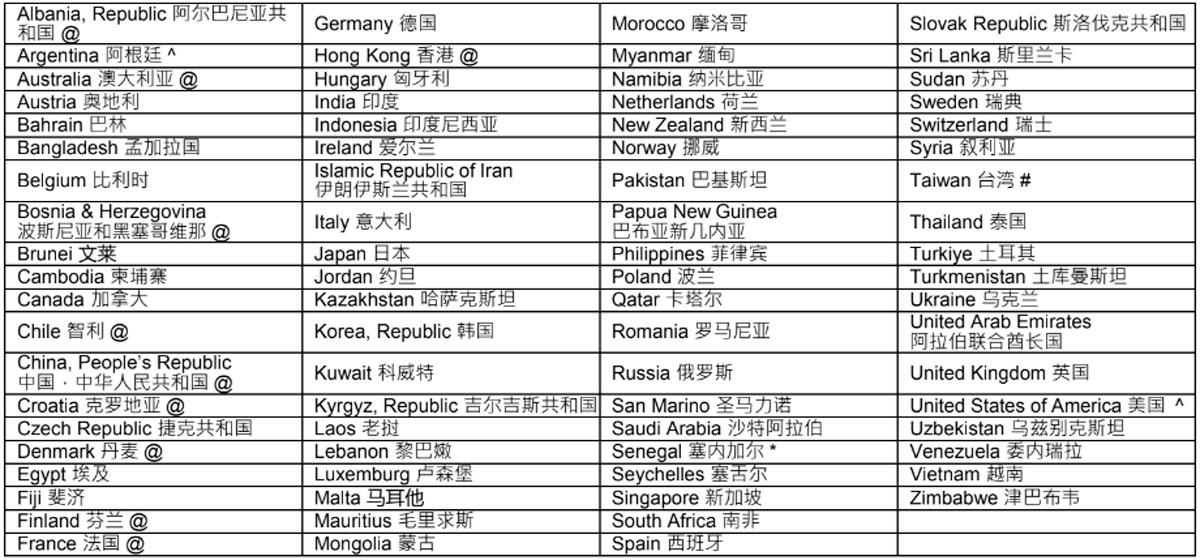
6) DOUBLE TAXATION AGREEMENT (DTA) WITH MORE THAN 70 COUNTRIES

Labuan Company enjoys the benefits of more double taxation treaties than any other offshore company as it almost enjoys same full double taxation benefit as Malaysia company except for fourteen (14) of those 78 countries, and it can enjoy full treaty benefit even with those fourteen (14) countries by incorporating a Malaysian domestic subsidiary company.

Malaysia has entered into Double Taxation Agreements with various countries as follows:-
Double Taxation Agreements-01
^ Limited Agreements
# Income Tax Exemption Order
@ Synthesized text
Currently, Labuan has been specifically excluded from Double Taxation Agreement with the countries as follows:-
Double Taxation Agreements-02

7) LIBERAL LABUAN EXCHANGE CONTROL ENVIRONMENT – FREE FLOW OF FUNDS

8) INVESTMENT PROTECTION AGREEMENT (IGA) WITH MORE THAN 50 COUNTRIES

9) THE CONFIDENTIALITY OF COMPANY, SHAREHOLDER AND DIRECTORS’ INFORMATION IS ENSURED

10) LABUAN COMPANY VS BVI COMPANY

Labuan Company
BVI Company
Labuan is low-tax jurisdiction country.
BVI is tax-free jurisdiction country.

Certain home country may impose the income tax law on incomes deriving from offshore, if they have not been taxed offshore, particularly, when they are remitted back, this may appy to BVI Co but not Labuan Co as it pays minimum tax.

Labuan Co enjoys more than 70 countries’ double tax treaties (DTAs).

BVI enjoys only 2 countries’ (Japan and Switzerland) double tax treaties (DTAs), and these treaties are not used in practise.

Dividend declared from Labuan Co to Malaysia is free of tax.

Dividend declared from BVI co may subject to income tax.

Note: If the company is Non-Malaysian Co, the tax exemption will depend on each home country’s law jurisdiction and its double tax treaties with Malaysia.

No withholding tax on interest payment.

BVI has applied the European Union (EU) Savings Directive since 1 July 2005. A withholding tax (initially 15%, rising to 20% from 1 July 2008) has been applied to interest payments to natural persons resident within the EU.

Labuan has its registered auditor under its jurisdiction. The income tax payable is allowed to base on the audited profit, the source of income is cleared for reinvestment or dividend purpose, once it is paid.

BVI has no registered auditor under its jurisdiction.

ILLUSTRATIONS ON LABUAN COMPANY STRUCTURE

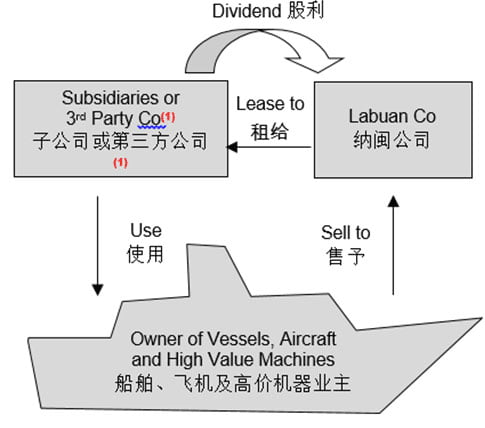
1) Labuan Leasing Company or Labuan Islamic Leasing Company

Suitable Industries

  • Vessel, aircraft, shipping, oil & gas, high value assets co.

Tax Advantages

  • Income tax is only 3% of net profit
  • Dividend income received by Labuan Co is exempted from tax.
  • No withholding tax on dividend declared And lease rental made by Malaysian subsidiaries or 3rd Party Malaysian Co.

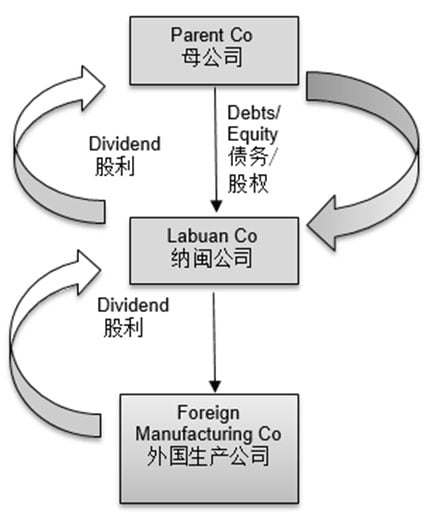
2) Investment Holding Company

Suitable Industries :

  • Investment holding or offshore investment.

Tax Advantages

  • Dividend income received by Malaysian Parent Co(1)  or Labuan Co is exempted from tax.
  • No withholding tax on dividend declared by Labuan Co to either Malaysian or Foreign Parent Co.
  • No withholding tax on interest charged by Malaysian or Foreign Parent Co to Labuan Co.
  • No Capital Gain Tax and stamp duty for the transfer of shares in Labuan Co, e.g. dispose the investment in Foreign Manufacturing Co by selling Labuan Co.
  • Enjoys double tax treaties with more than 70 countries via a Labuan Co.

3) Captive Insurance

Suitable Industries :

  • Captive Insurance

Tax Advantages

Income tax is only 3% of net profit

  • Dividend income received by Malaysian Parent Co(1) is exempted from tax.
  • No withholding tax on dividend declared by Labuan Captive Insurance Co.
  • Enjoys double tax treaties with more than 70 countries via a Labuan Co.

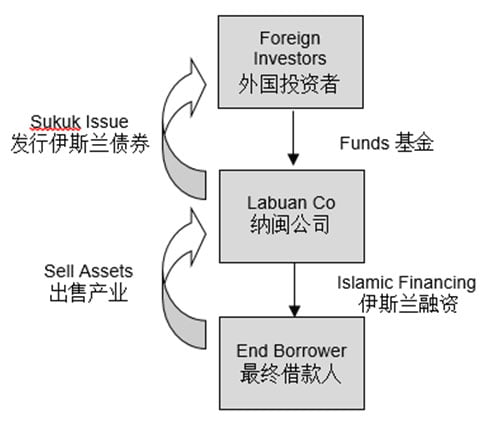
4) Offshore Financing

Suitable Industries :

  • Fund managers

Tax Advantages

  • Income from investment is exempted from tax for Labuan Co.
  • Dividend from Labuan Co is exempted from tax.
  • No withholding tax either on dividend declared by or interest charged from Labuan Co to Labuan Funds.
  • Distribution from Labuan Funds to investors is not subject to withholding tax.
  • Enjoys double tax treaties with more than 70 countries via a Labuan Co.

Other Advantages

  • Lower cost of funds.
  • Liberal Labuan exchange control environment.
  • Debt instruments of Labuan Co may be listed.
Investment Funds 投资基金
Islamic Financing 伊斯兰融资
Categories
Ideas & Insights Newsletter Transfer Pricing

Transfer Pricing Requirements And New Penalties in Malaysia

Transfer Pricing Requirements And New Penalties in Malaysia

Key Takeaway

  • Transfer Pricing Documentation is to be prepared annually
  • Changes in Form C disclosure items for related party transactions, interest expenses paid to related companies and CbyCR notification
  • CbyC Rules are applicable for companies with consolidated revenue of more than RM3 billion
  • New penalty rates have been introduced
This is a summary of the Transfer Pricing Requirements in Malaysia

Transfer Pricing Guidelines (“TPG”)

The 2012 TPG superseded the Guidelines previously issued in year 2003, and was intended to provide detailed guidance to taxpayers on how to comply with the requirements of the law under Section140A of Income Tax Act 1967 and the TP Rules 2012. The 2012 TPG is applicable to:
  • Controlled transactions between associated persons, where at least one party is assessable or chargeable to tax in Malaysia; and
  • Applies to both cross-border transactions and domestic related party transactions. The TPG need not be applied to domestic controlled transactions if it can be proven that any TP adjustments will not alter the total tax payable by both parties.
The guidelines reinforces that companies involved in related party transactions in Malaysia should prepare a TP documentation for the relevant year of assessment. While the TP documentation has to be prepared, it does not need to be submitted unless requested by the tax authorities. Companies who fall below this threshold may opt to prepare a limited scope TP documentation instead of a full scope TP documentation.
  • Companies with gross income more than RM25 million, and the total amount of related party transactions more than RM15 million; OR
  • Companies with financial assistance by related parties more than RM50 million.
A full scope report may consists of the following:
  1. Organizational structure
  2. Nature of business/industry and market conditions
  3. Controlled transactions
  4. Pricing policies
  5. Assumption, strategies and information regarding factors that influenced the price setting policies
  6. Comparability, functional and risk analysis
  7. Selection of the transfer pricing method
  8. Application of the transfer pricing method
  9. Financial information
  10. Other relevant/supporting documents

A simplified TP documentation consists of items (a), (c) and (d) as detailed below. Taxpayer is allowed to apply any method other than the five methods described in the TPG provided it results in arm’s length outcomes.

(a) Organizational Structure

  1. the taxpayer’s worldwide organizational and ownership structure covering all associated persons whose transactions directly or indirectly affect the pricing of the documented transactions; and
  2. a description of the management structure of the local entity, a local organization chart, and a description of the individuals to whom local management reports and the country(ies) in which such individuals maintain their principal offices.

(b) Controlled Transactions

  1. description of details of the property or services to which transaction relates; any intangible rights or property attached thereto, the participants, the scope, timing, frequency, type and value of the controlled transactions (including all relevant related party dealings in relevant geographic markets);
  2. names and addresses of all associated persons, with details of the relationship with each such associated person;
  3. the nature, terms (including prices) and conditions of transactions (where applicable) entered into with each associated person and the quantum and value of each transaction;
  4. an overview description of the business, as well as a functional analysis of all associated persons with whom the taxpayer has transacted;
  5. all commercial agreements setting forth the terms and conditions of transactions with associated persons as well as with third parties; and
  6. a record of any forecasts, budgets or any other financial estimates prepared by the person for the business as a whole and for each division or product separately.

(c) Pricing Policies

Details of pricing policy for each type of controlled transaction shall include:
  1. the formula adopted, including anticipated profit margin/mark-up and cost component;
  2. how the formula is applied;
  3. who determine the pricing policy & how often is the policy being revised;
  4. sample of documents to support the pricing policy; and
  5. comparability study to ensure the arm’s length price.

Income Tax (Country-by-Country Reporting) Rules 2016 (“CbyCR Rules”)

In 2017, the tax authorities issued the CbyCR Rules followed by the Labuan CbyCR Regulation, effective from 1 January 2017 and is applicable to MNE Groups with total consolidated group revenue of at least RM 3 billion. The rules state that the ultimate parent (reporting entity) would have to complete the CbyC Report and submit it to the tax authorities on or before 12 months from the last day of the reporting FY (i.e. 31 December 2021 if the tax payer’s year end is 31 December 2020).

Additionally, there is also a requirement for the Malaysian Companies to notify the tax authorities under Subrule 6(1) and 6(2) of the PU (A) 357/2016 either by disclosing the information as part of the tax returns or by submitting the manual notification form.

Malaysian parent entities and subsidiaries submitting the Form C , TR , TA , TC or TN (tax return forms, whichever is applicable) can furnish the notification by way of tax returns while companies filing Form LE & TF are required to furnish the notification using a manual notification form as follows:
Type of entity
Details
Reporting entity
[Annex B1]
The reporting entity shall notify the Director General in writing if it is the ultimate holding entityon or before the last day of the reporting FY (i.e. 31 December 2021 if the tax payer’s year end is 31 December 2021). Notification will have to include details of all Malaysian and foreign non-reporting constituent entities (Annex B1)
Non-reporting entity
[Annex C1 & C2]
The Malaysian subsidiary does not have to submit the CbyCR but they shall notify the Director General in writing of the identity and tax residence of the reporting entityon or before the last day of the reporting FY (i.e. 31 December 2021 if the tax payer’s year end is 31 December 2021). There are two types of notification for non- reporting entity as follows:

a. Notification for non-reporting entities whose reporting entity is in Malaysia
b. Notification for non-reporting entities whose reporting entity is outside Malaysia

Tax Return Form

Throughout the year from FY 2014 to FY 2021, the income tax return form has been amended to include additional disclosures as follows:
  1. Disclosure on whether tax payers carry out controlled transactions under Section 139 and 140A Tax payer is to disclose all type of transactions they are involved in with a related party and the amount. Tax payer would also have to declare if TP documentation have been prepared.
  2. Disclosure of whether the taxpayer is subject to interest restriction under Section 140C.
    Tax authorities introduced Restriction on deductibility of interest under Section 140C of the Income Tax Act 1967, effective 1 July 2019 onwards aimed at restricting the deduction of interest expense in relation to cross border transaction. The Rules are applicable to:
    • companies who have been granted any financial assistance in a controlled transaction;
    • the total amount of any interest expense for all such financial assistance exceeds RM500,000 in the basis period.
    The maximum amount of interest that is deductible is 20% of the Tax EBITDA. The balance is allowed to be carried forward.
  3. Disclosure on CbyCR
    Tax payer is to disclose if CbyCR is relevant for the Group and fill in the relevant information of the reporting entity.

Transfer Pricing Penalties and Power to Disregard Structures

Failure to furnish contemporaneous Transfer Pricing documentation

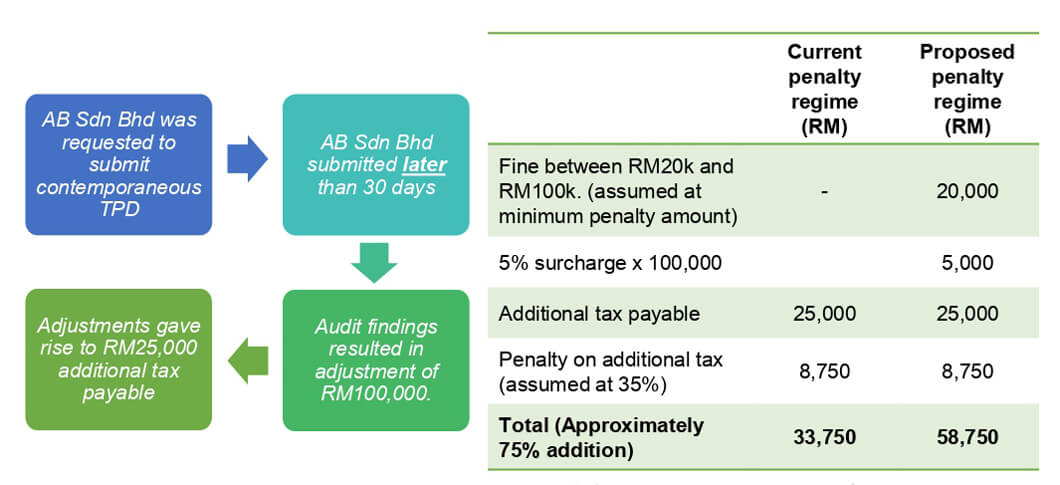
With the introduction of Section 113B of the ITA, any person who fails to furnishing a contemporaneous TPD shall be liable to the following:
  1. Fine of not less than RM20,000 and not more than RM100,000; or
  2. Imprisonment for a term not exceeding six (6) months; or
  3. Both.
    1. The new section also empowers the Director General to impose a penalty as stated in (a) if taxpayer is not prosecuted for failure to furnish TP contemporaneous documentation. Taxpayers can appeal on the decision with the Special Commissioners of Income Tax but the burden of proof is on the taxpayers.

5% surcharge on Transfer Pricing adjustments

Under Section 140A (3C), the Director General may impose a surcharge of not more than 5% of the total transfer pricing adjustments regardless if there is any additional taxes payable by the taxpayers. Any surcharge imposed shall be treated as collection tax and would not be treated as a tax payable under any other provision within the ITA.

Power to disregard structure in controlled transactions

Under S140A (3A) and (3B), the Director General will be empowered to disregard any related party transaction structure adopted by the company if he is of the opinion that:
  1. The economic substance of that transaction differs from its form; or
  2. The commercial reality of that transaction differs from the arrangement which would have been adopted by an independent party.
In these circumstances, the Director General will be allowed to make adjustments to the structure to reflect the structure that would have been adopted in a third party arrangement.

Failure to comply (after adjustments have ben issued)

Penalties will be imposed under subsection 113(2) and the TP Audit Framework 2019. The rates can range from 30% to 100% depending on whether the TP documentation is prepared contemporaneously in accordance with the requirements and submitted within 14 days.

Illustration on Penalties

Illustration on Penalties

Transfer Pricing Audit Framework 2019

For Companies who fail to comply, penalties will be imposed under subsection 113(2) of Income Tax Act 1967 (“ITA”) and the TP Audit Framework 2019. The rates from the framework are as follows, divided between normal cases and voluntary disclosure cases (“VD”):
Condition
Penalty Rate
(Normal Case)

Penalty Rate
(VD)

Understatement or omission of income
100%
100%
Taxpayer did not prepare TP documentation

50%

NA

Taxpayer has prepared and submitted the TP documentation with the VD but not in accordance to the requirements; OR;Taxpayer has prepared a comprehensive and good quality TP documentation but failed to submit within timeline provided.

30%

20%

Taxpayer has prepared and submitted a comprehensive and good quality TP documentation with the VD in accordance to the requirements; OR; Taxpayer has prepared a comprehensive and good quality TP documentation and submitted within timeline provided.

0%

0%
Categories
Ideas & Insights Newsletter Tax

Is Your Interest Tax Deductible?

Is Your Interest Tax Deductible?

Key Takeaway

  • Deduction rules on interest expenses incurred on loan or borrowings taken for business.
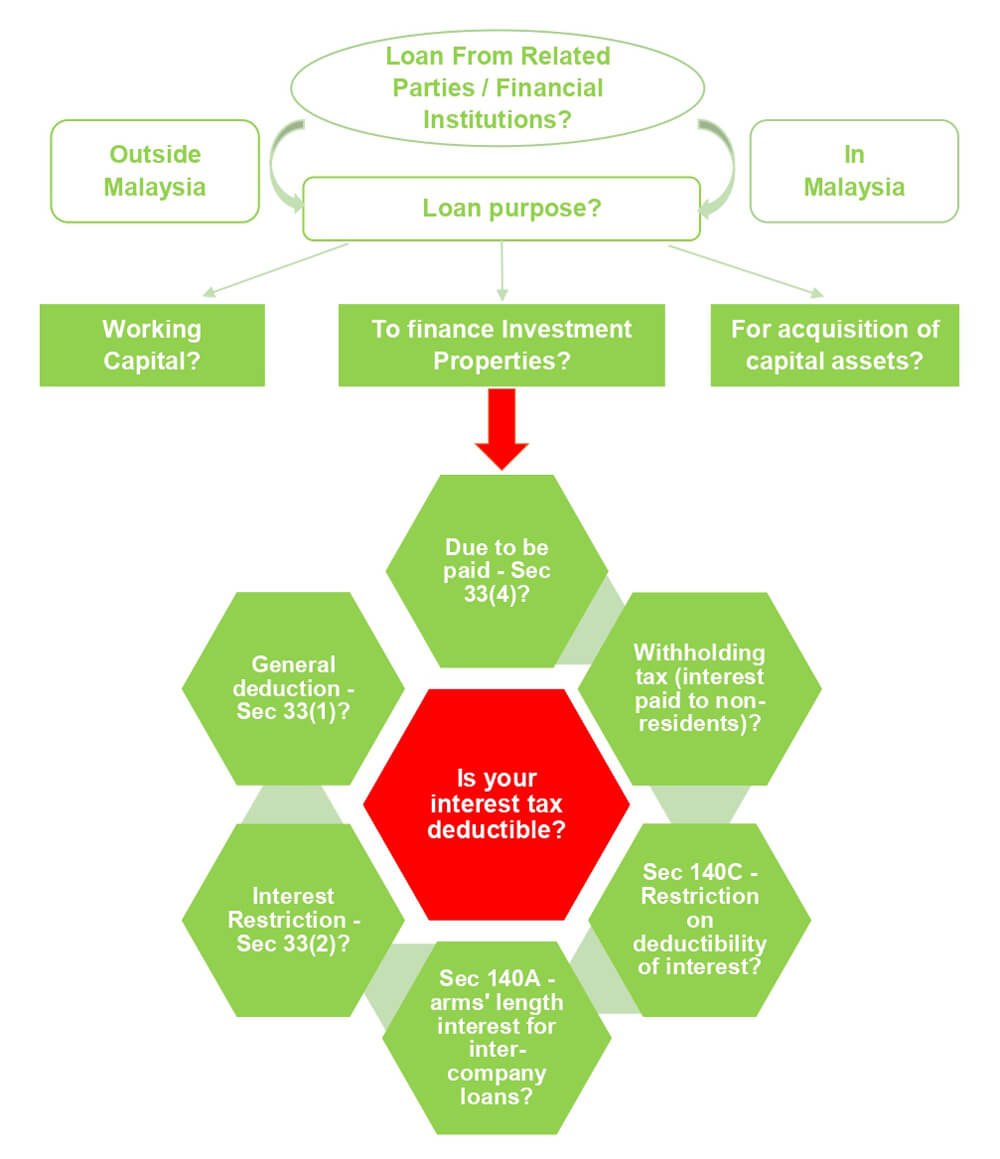
  1. Borrowing is very important for the businesses. However, the source of borrowing whether is local or overseas; the parties to whom we borrowed from; the purposes of and use for the borrowings will affect the deductibility of the interest.
  2. Therefore, the rules on interest deductions (borrowing which generate interest expenses) can be complex.

Is Your Interest Tax Deductible?

Interest Tax Graph
Categories
Ideas & Insights Newsletter Tax

Capital Statement: Does Your Declared Income Support Your Accumulated Assets?

Capital Statement: Does Your Declared Income Support Your Accumulated Assets?

Key Takeaway

  • Tool used by the IRB to detect under-declared income
  • Rationale of the capital statement approach
  • The importance of maintaining complete records

What Is A Capital Statement?

  • The personal ‘balance sheet’ of an individual
  • It puts together all the assets and liabilities of an individual, adjusted for non-taxable income/losses and the individual’s private and personal expenses
  • One of the most effective tools used by the Inland Revenue Board (‘IRB’) to ascertain whether an individual has under-declared income in the past

Assets Scrutinised By The IRB

  • Properties
  • Motor vehicles
  • Shares and other investments (listed AND private companies)
  • Bank accounts (local AND foreign bank accounts)
  • Credit card accounts,
  • Directors’ account balances

Period Covered During An Audit/Investigation

  • Normally covers a period of the past six years

Challenges Faced By The Taxpayer

  • Loss of documents
  • Unable to recall the transactions or flow of funds

Capital Equation

capital equation
Categories
Ideas & Insights Newsletter Tax

Automation Capital Allowances

Automation Capital Allowances

Key Takeaway

  • 200% Automation Capital Allowance on first 2 million to 4 million expenditure incurred within YA 2015 to 2023;
  • Effective date of application : 1 Jan 2015 until 31 Dec 2023;
  • High labour-intensive industries or industries adopt the automation process.
The Automation Capital Allowance (Automation CA) was introduced to encourage adoption of automation among manufacturing companies.

It is divided into two (2) categories:-
Categories
Incentives
High labour-intensive industries (rubber products, plastics, wood, furniture and textiles)
Automation CA of 200% on the first RM4 million expenditure incurred within year of assessment from 2015 to 2023.
Other industries
Automation CA of 200% on the first RM2 million expenditure incurred within year of assessment 2015 to 2023.

Eligibility Criteria

  • Manufacturing companies incorporated under Companies Act 1965 / 2016;
  • Resident in Malaysia;
  • Engaged in manufacturing activities at least 36 months;
  • Automation machine or equipment used directly in manufacturing activities.
Effective date of application:
Application received by Malaysian Investment Development Authority (MIDA) from 1 January 2015 until 31 December 2023 is eligible to be considered for this incentive.
Source: Malaysian Investment Development Authority
Categories
Ideas & Insights Newsletter Tax

Phase One Of Movement Control Under National Recovery Plan (NRP) Updates to the Inland Revenue Board’s Announcement (Updated 26 June 2021)

Phase One Of Movement Control Under National Recovery Plan (NRP) Updates to the Inland Revenue Board’s Announcement

(Updated 26 June 2021)

Key Takeaways

  • Extension of time for the submission of tax returns
  • Extension of time for tax payments
  • Submission of appeal to IRBM
  • Real Property Gain Tax (RPGT)
  • Stamp Duty
Following to the extension of Phase One of Movement Control under National Recovery Plan (NRP), the Inland Revenue Board of Malaysia (IRBM) has issued ‘Frequently Asked Questions (FAQ) On Tax Matters During The Movement Control Order Period’ (Updated on 26 June 2021).

This FAQs include extension of time for submission of forms/ returns/ documents, tax payments etc during the phase one (of NRP) period.

For the full FAQ, please visit: http://phl.hasil.gov.my/pdf/pdfam/faq_pkp3_2.pdf
 
Question
Remarks by IRB
No.
General
(a)
Extension of time to submit documents for audit or investigation within the MCO 3.0 period.
Application for extension of time must be submitted by letter/email to IRBM branch which handle the case.
(b)
Extension of time to provide feedback to IRB letters within the MCO 3.0 period.
Application for extension of time must be submitted by letter/email to IRBM branch which handle the case.
No.
Forms
(a)

Extension of time to submit documents for audit or investigation within the MCO 3.0 period.

Deadline for submission of return forms is stated in the 2021 Return Form Filing Programme:-
http://phl.hasil.gov.my/pdf/pdfam/ProgramMemfailBN_2021_Pin.3_ 2.pdf

  1. Return Form for Companies, Limited Liability Partnerships, Unit Trusts / Property Trusts, Co-operative Societies, Trust Bodies, Real Estate Investment Trusts / Property Trust Funds and Business Trusts:-
    1. For Year of Assessment (YA) 2020 (with accounting period ending 1 October 2020 until 31 December 2020):
      • Extension time of two (2) months will be given from the due date of submission.
    2. For Year of Assessment (YA) 2021 (with accounting period ending 1 January 2021 until 31 January 2021:
      • Extension time of two (2) months will be given from the due date of submission.
  2. Return Form for petroleum with accounting period ending 1 October 2020 until 31 December 2020:
    • Extension time of two (2) months will be given from the due date of submission.
  3. Return Form for petroleum with accounting period ending 1 January 2021 until 31 January 2021:
    • Extension time of two (2) months will be given from the due date of submission.
  4. Return Form for Year of Assessment 2020 for taxpayers CARRYING ON BUSINESS involving Individuals, Resident Individuals (Knowledge /Expert Workers), Non-Resident Individuals, Non-Resident Individuals (Knowledge / Expert Workers), Partnerships, Associations, Deceased Persons Estate and Hindu Joint Families:
    • Extension of time (EOT) granted until 31 August 2021.
(b)
Extension of time for the submission of revised CP500 and CP204 where the due date falls on June 2021.
Extension of time is given until 31 July 2021.

(c)

Submission of Forms CP22 within the MCO 3.0 period.

Form CP22 can be submitted through Customer Feedback Form :-
https://maklumbalaspelanggan.hasil.gov.my/MaklumBalas/en-US/

(d)

Submission of application for tax clearance letter (TCL) within the MCO 3.0 period.
  1. Application can be submitted as follows:-
    1. e-SPC;
    2. Customer Feedback System:
      http://www.hasil.gov.my/bt_goindex.php?bt_kump=2&b t_skum=5&bt_posi=1&bt_unit=3&bt_sequ=1&bt_lgv=2
  2. By post or appointment only.

(e)

Submission of Notice of Appeal (Form Q) to the Special Commissioners of Income Tax (SCIT) where the due date falls within MCO 3.0 period.
Application for extension of time must be done in writing by completing Form N and submitting to IRBM branch. The appeal will be considered based on the merits of case. Taxpayer is required to file Form N and state that the delay is due to the implementation of MCO 3.0.

(f)

Submission of Country-by- Country Reporting (CbCR) where the due date falls within MCO 3.0 period.
Application for extension of time must be submitted in writing to Department of International Taxation and the appeal will be considered based on the merits of the case.

(g)

Submission of Form CP 204 and notification of change of accounting period (CP204B) which due date falls on June 2021.
Extension of time is given until 31 July 2021. CP204B needs to be submitted by post or courier.
(h)
Revision of tax estimate payment (CP204) in the 3rd month of 2021.
No revision is allowed for the 3rd month instalment. Taxpayers must submit the relevant CP204 revision in the 6th / 9th month in the basis period of the business through e-CP204A.
No.

Payments

(a)

Extension of time for tax estimate payments (CP204) due on June 2021.
No extension of time. Tax payer can make payment via online services at ByrHasil.

(b)

Extension of time for other tax instalment payments relating to audit and investigation due on June 2021.
No extension of time. Tax payer can make payment via online services at ByrHasil.

(b)

Extension of time for submission of MTD data and payment of Monthly Tax Deduction / CP38 for remuneration on employment due on 15 June 2021.
No extension of time. Taxpayer can make payment via online services at e- PCB, e-Data PCB dan e-CP39.

(d)

Deferment for compound and penalty payment which due within 1 June 2021 until 28 June 2021.
Extension of time is given up to 30 days from the initial due date for payment.

(e)

Re-scheduling of tax instalment payments.
Tax payer is required to submit the application with the relevant documents such as cash flow documents etc.

(f)

Extension of time for withholding tax payment which due within the MCO 3.0 period.
No extension of time is given. Withholding tax payment can be made via telegraphic transfer by furnishing complete payment details to IRBM via fax at 03-62019637 or e-mail to HelpTTpayment@hasil.gov.my.
No.
Appeal and Penalty Payment

(a)

Application for appeal on the penalty imposed by IRB.
Taxpayer may submit the application for appeal on tax penalty for the following cases:
  1. Unpaid penalties;
  2. Penalties that have been imposed and subject to instalment schedule

(b)

Application for appeal on the tax increase.

Application for appeal on tax increase can be submitted through Customer Feedback Form available at IRBM’s Official Portal:
https://maklumbalaspelanggan.hasil.gov.my/MaklumBalas/en-US/

(c)

Application for appeal on deferment of payment of outstanding penalty imposed to year 2022.

Application for deferment of payment can be submitted through Customer Feedback Form available at IRBM’s Official Portal:
https://maklumbalaspelanggan.hasil.gov.my/MaklumBalas/en-US/

No.
Real Property Gains Tax (RPGT)

(a)

Extension of time for the submission of RPGT return forms where the due date falls in June 2021.
Extension of time is given until 31 July 2021.

(b)

Appeal on RPGT penalty.
Appeal will be considered based on merits of the case.
No.
Stamp Duty

(a)

Appeal on stamp duty penalty.
Appeal will be considered based on merits of the case.

(b)

Extension of time for stamping which cannot be done within the MCO 3.0 period.
Appeal will be considered based on the merits of the case.
Application for extension of time must be made within 30 days from the date of documents.
Categories
Ideas & Insights Newsletter Tax

Introduction to Withholding Tax and Imported Services Tax – Implications of Digital Services (PART 3)

Introduction to Withholding Tax and Imported Services Tax - Implications of Digital Services (PART 3)

Key Takeaway

  • Withholding Tax on Foreign Service Providers
  • Service Tax on Digital Services
Part 3 of this article will focus on digital service tax and service tax issues on imported services for e-Commerce transactions, under the Service Tax Act 2018.

What is Imported Service?

“Imported taxable service” means any taxable service acquired by any person in Malaysia from any person who is outside Malaysia (Section 2 of Service Tax Act 2018)

What is Digital Service?

“Digital service” means any service that is delivered or subscribed over the internet or other electronic network and which cannot be obtained without the use of information technology and where the delivery of the service is essentially automated;”.
Digital Service
With effect from 1 January 2019, regardless if you are either a Service Tax-registered person or Non-Service Tax-registered person, you are required to file a return and pay the service tax in respect of all taxable services that you procure from overseas suppliers, if such taxable services fall under Group G and I of Service Tax Regulations 2018.

Types of Digital Service

  • Software, Application & Video Games
  • Music, e-book and film
  • Advertisement and online platform
  • Search engines and social networks
  • Database and hosting
  • Internet Based Telecommunication
  • Online Training
  • Others (such as subscriptions to online newpapers and journals etc.)
Categories
Ideas & Insights Newsletter Tax

Introduction to Withholding Tax and Imported Services Tax – Implications of Digital Services (PART 2)

Introduction to Withholding Tax and Imported Services Tax - Implications of Digital Services (PART 2)

Key Takeaway

  • Withholding Tax on Foreign Service Providers
  • Service Tax on Digital Services
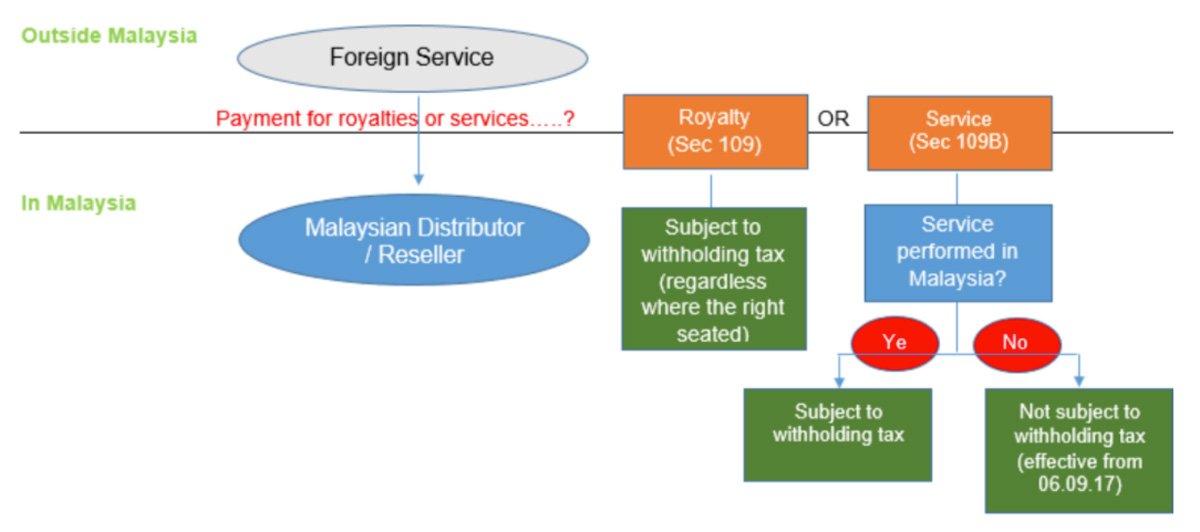
Part 2 of this article will focus on withholding tax issues around ‘royalties’ (Section 109, Income Tax Act 1967) and ‘services’ (Section 109B, Income Tax Act 1967) for e-Commerce transactions.

What is e-Commerce?

Any commercial transactions conducted electronically including the provision of information, promotion, marketing, supply, order or delivery of goods and services (even though payment and delivery relating to such transactions may be conducted offline).

Withholding tax implications

To determine the nature for payment of e-commerce services (i.e Royalties or Services?)
e-commerce

Example of payments under e-commerce transactions

Online advertising on Facebook, online payment such as Paypal, payment for cloud computing service, payment for subscription to content aggregators etc.

Important

Payment made may fall under Sec 109 instead of Sec 109B and penalty will be imposed due to non- compliance with withholding tax rules.
Categories
Ideas & Insights Newsletter Tax

Introduction to Withholding Tax and Imported Services Tax – Implications of Digital Services (PART 1)

Introduction to Withholding Tax and Imported Services Tax - Implications of Digital Services (PART 1)

Key Takeaway

  • Withholding Tax on Foreign Service Providers
  • Service Tax on Digital Services
In this present age, business cannot avoid but to rely on digital services to reach out to their customers and suppliers in order to operate or enhance their business functions. The reliance on digital services to conducting a business is accelerated particularly so with the Movement Control Order (MCO) being implemented in Malaysia which limits the ability of businesses to continue doing business, the ‘traditional’ way. Some of the most common digital services relied on by businesses would include software applications, digital advertising, payment gateways and cloud storage, which are generally dominated by foreign service providers such as Google, Microsoft and Facebook.

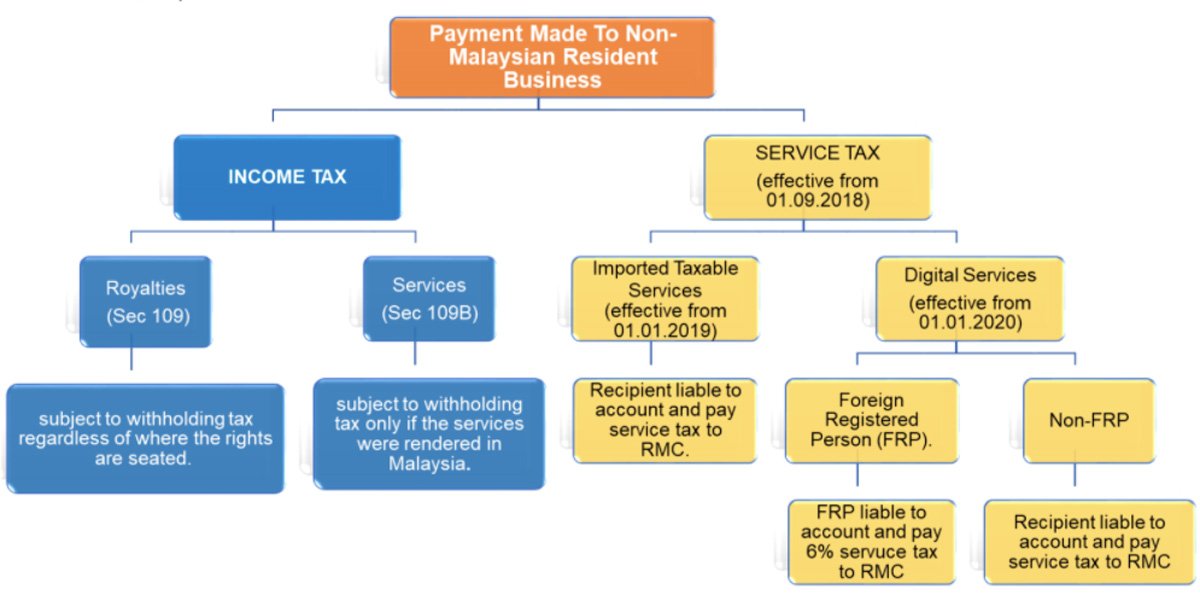
Such digital services would obviously involve payments for the use of such digital services to the service providers and therefore, you have to be aware of the tax implications behind the use of digital service, namely:

  1. Withholding tax under the Income Tax Act 1967; and
  2. Digital service tax or imported services tax under the Service Tax Act 2018.

This series of short articles intend to provide some general guidance on the tax implications of payments for such services to service providers who are not residing in Malaysia.
You also need to take note that in some cases, both service tax and withholding tax can apply on the same service, as per the illustration as below:-
Payment Made to Non-Malaysian Resident Business
Categories
Ideas & Insights Newsletter Tax

Employers Responsibility under the Income Tax Act

Employer Responsibilities under Malaysia’s Income Tax Act (2025 Guide)

Key Takeaway

  • To inform IRBM any new employee within 30 days.
  • To inform IRBM the cessation/retirement/death of an employee.
  • To inform IRBM within 30 days before the date of employee intending to leave Malaysia.

As an employer in Malaysia, understanding and complying with the Income Tax Act 1967 is essential to avoid penalties and ensure smooth operations. This updated 2025 guide covers your key obligations—from monthly tax deductions to year-end reporting and employee notifications—complete with deadlines and online filing tools.

Key Employer Deadlines — 2025 Overview

Obligation Deadline Notes
Form EA (CP8A) to employees
28 Feb 2025
Must issue even to former or contract workers
Form E (Employer Return) to LHDN
31 Mar 2025 (manual); 30 Apr 2025 (e-Filing)
Required even with no employees
Monthly Tax Deduction (MTD/PCB)
By 15th of following month
Via e-PCB Plus (e-CP39) system
New Employee Notification (CP22)
Within 30 days of hiring
Mandatory via MyTax e-CP22 from 1 Sep 2024
Cessation Notification (CP22A/CP22B)
≥30 days before end of employment
Submit via MyTax e-SPC, withhold final payment until clearance granted
Employee Departure (CP21)
≥30 days before departure
Notify via e-SPC; withhold final pay until tax cleared

Monthly Compliance: MTD/PCB

Employers must:

  • Hold an employer “E” number.
  • Use employee’s TP3 (prior employment data) and TP1 (claims like zakat) correctly.
  • Deduct MTD using standard tables/computerised payroll.
  • Remit to LHDN via e‑PCB Plus by the 15th each month.
  • Maintain records for at least 7 years.

Penalties range from fines up to RM20,000, or imprisonment, or both, under Section 120 of the ITA

Year-End Obligations

Form EA (Statement of Remuneration)

  • Distribute to all employees (including ex-staff) by 28 Feb 2025.
  • Contains salary, allowances, EPF/SOCSO, PCB details.
  • Penalties: up to RM20,000 fine, 6 months imprisonment, or both

Form E (Employer’s Annual Declaration)

  • Submit to LHDN by 31 Mar 2025 (manual) or 30 Apr 2025 (e‑Filing).
  • Reports all employee remuneration and tax deductions.
  • Penalties: RM200–RM20,000, imprisonment, or both

LHDN requires employers—regardless of business type or number of employees—to submit Form E electronically

Employee Lifecycle Notifications

New Employees (CP22)

Submit within 30 days of hire via MyTax e‑CP22 (mandatory since 1 Sept 2024)

Cessation (CP22A / CP22B)

  • Notify ≥30 days before termination/retirement/death via e‑SPC.

  • Must withhold final payment until tax clearance (up to 90 days)

Departure from Malaysia (CP21)

  • Submit ≥30 days before expatriate leaves via e‑SPC.

  • Should retain final salary until tax clearance is issued

Notification of Commencement / Cessation of Employment of an Employee

Pursuant to Section 83 of the Income Tax Act 1967 (ITA 1967), we wish to remind all employers of their responsibility to inform the Inland Revenue Board of Malaysia (IRBM), via prescribed forms (as below), on the following:

Table 1:

Employer’s responsibilities
Subsection

Penalty/Fine

Form
To inform IRBM if there is a new employee.
Subsection 83(2) ITA 1967

Failure to notify will result in the employer being charged under paragraph 120(1)(c) and / or subsection 107(4)

To inform IRBM if there are any cessation/retirement/death of an employee*
Subsection 83(3) ITA 1967
Failure to notify will result in the employer being charged under paragraph 120(1) (c) and / or subsection 107(4)
To inform to IRBM not more than 30 days before the date of an employee intending to leave Malaysia
Subsection 83(4) ITA 1967
Failure to notify will result in the employer being charged under paragraph 120(1) (c) and / or subsection 107(4)

Please take note that while Section 83 of the ITA 1967 provides that the law applies in the situation where the employer commences, or about to cease to employ an individual who is or is likely to be chargeable to tax in respect of income in respect of gains or profits from the employment, the IRBM has recently adopted the practise of applying such requirements to ALL employees who have commenced employment, or cease to be employed by the employer.


All applications should be made by the employer to IRBM by the following methods:

  1. e-SPC at IRBM official website; or
  2. Form which can be downloaded from IRBM official website (please refer to TABLE 1 above).

What Happens if You Don’t Comply?

Failure to comply with the above may result in, upon conviction of an offence under Section 120 of the ITA 1967, the employers being liable to a fine of not less than RM200 and not more than RM20,000 or to imprisonment for a term not exceeding six months or to both.

  • Missing Form EA or E deadlines may result in fines up to RM20,000, imprisonment for up to 6 months, or both 
  • Failure to submit CP forms or remit PCB can lead to similar legal consequences
  • ITA Sections 120–114 specify escalating penalties for non-compliance

FAQ

By 28 February every year for the prior year’s earnings.

31 March (manual) or 30 April (e-Filing) annually.

Monthly by the 15th of the following month via e‑PCB Plus

Submit CP21 via e‑SPC ≥30 days before departure and withhold final pay until tax clearance.